October Build Contest Thread: Spooky Secrets!

Graveyard Shift update: it’s live on Esmeralda :green_circle:

The confidential payroll template is now published on the Ootle testnet, and it has paid a real night shift:

Open the shift tx and you’ll see the events Hired, Hired, PeriodOpened {period: 1} and ShiftPaid {period: 1, paychecks: 2}. No amount appears anywhere. Reading the same outputs back from the public indexer:

  • the night nurse’s key opens only her stub: 3000, “12 nights, ward 13”
  • the gravedigger’s key opens only his: 2500, “9 plots, lantern allowance”
  • the auditor’s view key reads 3000 + 2500 + 4500 treasury = 10,000 = the public budget :check_mark:

The faucet was dry, so I funded this by CPU-mining Esmeralda and burning tXTM over the burn/claim bridge. The whole deployment cost about 1.5 tTARI in fees. examples/live_esmeralda.rs in the repo builds the transactions and re-runs that check against the indexer, so anyone can reproduce it.

Code: GitHub - XachP/graveyard-shift: Confidential payroll template for Tari Ootle (Spooky Secrets contest entry) · GitHub · Browser demo: Graveyard Shift · confidential payroll on the Tari Ootle

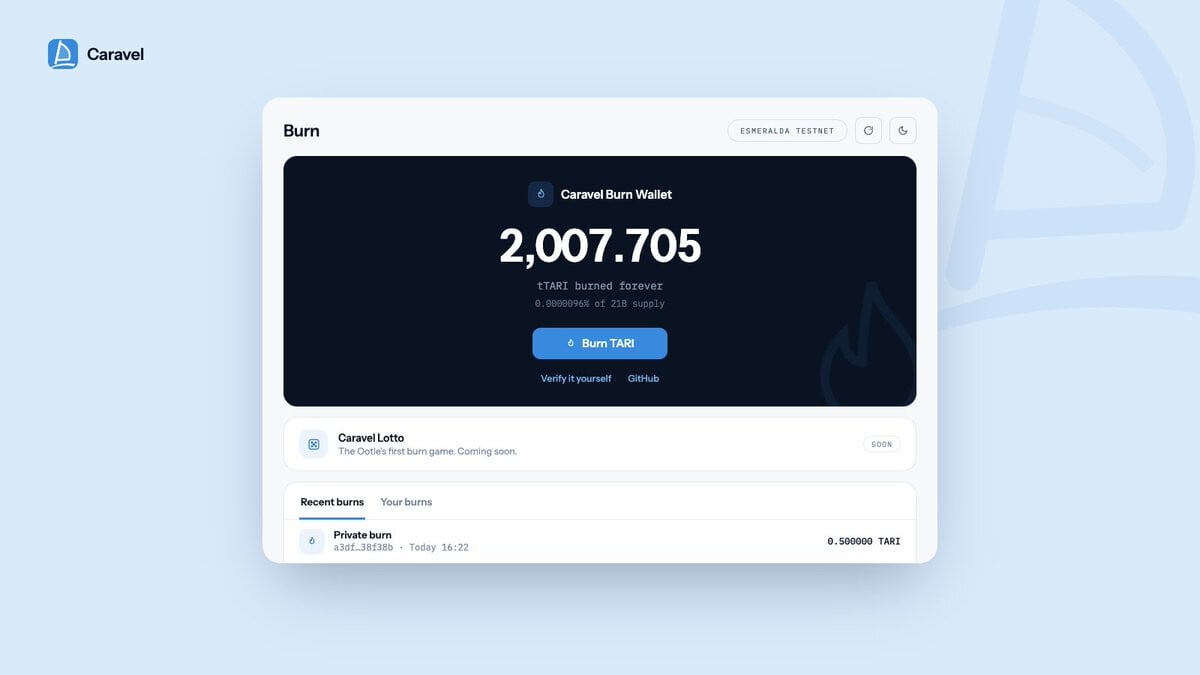
Caravel Burn Wallet: a private, verifiable burn wallet on the Tari Ootle

Description
The Caravel Burn Wallet is a burn wallet on the Tari Ootle that anyone can use and anyone
can verify. The Council mentioned wanting to burn the fees generated from the initial
Ootle launch, so I built a burn wallet they (or anyone) can audit and use.

  • Deposit-only and ownerless: TARI can go in, but nothing can ever come out. No owner, no
    admin key, no withdraw function.
  • The total burned is public and verifiable on chain at any time.
  • Burns can be private: nothing ties a private burn to your account, but the amount is
    still counted in the verified total.
  • Any project can integrate it to burn a portion of its fees forever. Caravel Trade
    already burns 0.3% of every trading fee through it.

So far: 13,128.73 TARI burned. There’s also a 25,000 XTM bounty for anyone who can rug the
wallet: Caravel on X: "1/ New in Caravel ⛵ We've been cooking the @tari Ootle's first burn-centred game 🎲🔥 As that progresses, here's our next ecosystem contribution: the Caravel Burn Wallet. Deposit only, never withdraw ... Not even us. Think you can rug it? Winner takes all: 10,000 $XTM 😏 https://… / X

Links

Tari payment address
129Wf58tMXfYvqtQgQiuZbs8V75vGKKMPZGKSYVbQNvPDeHwaJ5VzjFXEhpsTEXs5NUbHm2JUVVum5Be1DKs1Zg9Sg7

1 Like

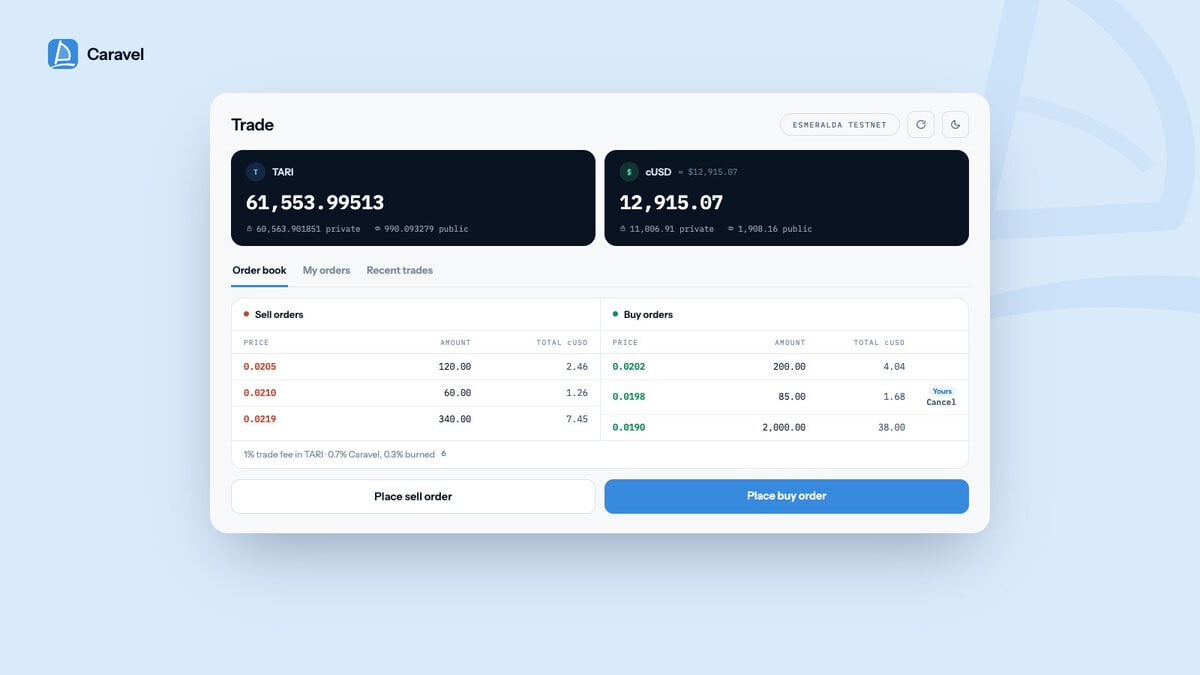
Caravel Trade: a private peer to peer OTC platform on the Tari Ootle

Description
Caravel Trade is a peer to peer OTC platform on the Tari Ootle that lets you trade TARI
using the Ootle’s privacy features. To support it, I created a test token, Caravel USD
(cUSD), as a placeholder for a future Ootle stablecoin.

  • Place a buy or sell order for TARI, priced in cUSD.
  • Non-custodial: your funds sit in the order contract, never with Caravel. Only you (by
    cancelling) or a matching trade can release them.
  • Orders fill whole in a single transaction, and you can cancel anytime.
  • Private by default: amounts and balances stay hidden, from placing an order to getting paid. You can choose public at any step.
  • 1% fee per trade, paid in TARI: 0.7% to Caravel and 0.3% burned forever through the
    Caravel Burn Wallet (my other entry).

Links

Tari payment address
129Wf58tMXfYvqtQgQiuZbs8V75vGKKMPZGKSYVbQNvPDeHwaJ5VzjFXEhpsTEXs5NUbHm2JUVVum5Be1DKs1Zg9Sg7

1 Like

@XachP @DevXTools

You should both now be able to edit your previous posts. Please do so and update your existing posts.

Anyone else who needs to do this, please reply to this comment asking for perms.

@Fox could I get edit permission for my entry (post 17)? Two of its explorer links no longer resolve and I would like to update them. Thanks!

@Kylne700 Granted. You should be able to edit now.

1 Like

Arkimals — hatch a secret canine on Tari :jack_o_lantern:

Play: https://tari.staging.arkimals-game.com/
Source code: GitHub - BlackTurtle123/tari-midnight-kennel: Arkimals on Tari: encrypted canine surprises, voluntary NFT reveals, breeding and Halloween rebirth on Esmeralda. · GitHub
License: MIT

Arkimals is a Halloween canine game built for the Spooky Secrets contest.

Choose a haunted doorstep and receive a surprise canine through a native encrypted Tari stealth memo. Open it privately in Sapient, then choose when to reveal it and mint your NFT. Build your pack through breeding, Halloween rebirth and staking.

How it uses Tari privacy

The game commits to a canine outcome with a fresh random salt. Its opening is delivered through an encrypted wallet memo, and the browser verifies the decrypted preview against the on-chain commitment. When the player explicitly reveals, the contract checks the signer and commitment and mints the NFT exactly once to the fixed recipient.

The operator knows the surprise. Account activity and transaction timing can be public, and revealing publishes the NFT’s traits. The privacy feature is confidential delivery with a voluntary reveal.

The game runs on Esmeralda testnet. Each new incubation contributes 20 test tTARI to the delivery treasury, plus network fees. The Tari implementation was developed in October 2026 and uses existing Arkimals branding and artwork.

Reddit announcement:

Tari mainnet prize-payment address:

12CK76XMuGGBCEuo1YeZU6rj4hqdXMVEvF9JgrvpQnWXarAL1he1casYoFr2RhT6RQfw6kZ2cmkhc4BiZKmsCkLH8Ev
1 Like

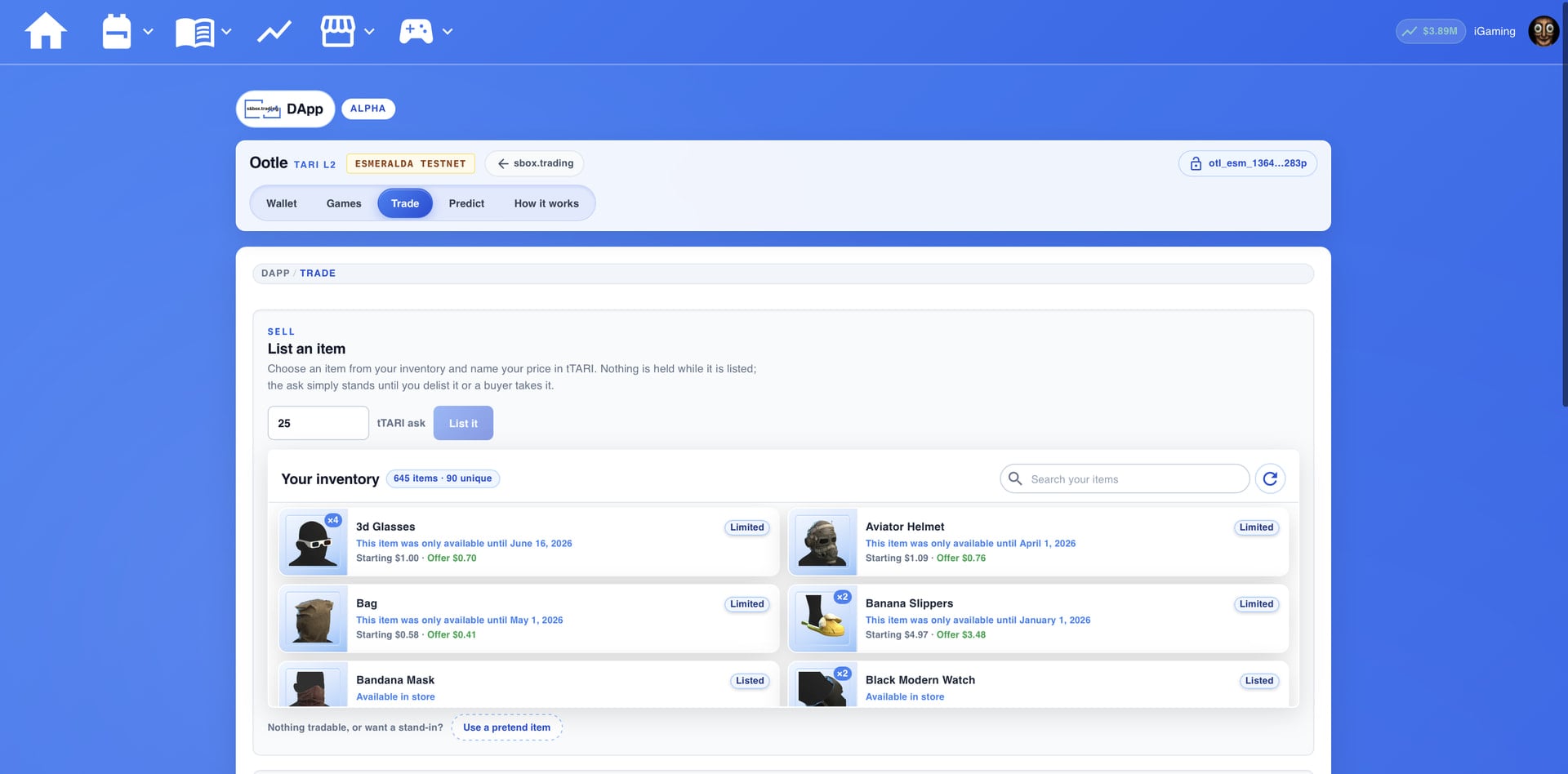
Ootle @ sbox.trading (Spooky Secrets Contest Entry)


Project Description

What is the Secret?

On traditional third-party Steam community marketplaces, high-value inventory holders and active traders are constantly profiled. Scrapers track who owns what, how much store credit they hold, what they bet, and who they trade with. Worse, platform balances are locked inside custodial databases where a single compromise exposes every user’s holdings.

We built Ootle Steam Kit — an open-source, bring-your-own-game Steam + Tari Ootle L2 DApp (running live on the Esmeralda testnet) that brings self-custodial keys and on-chain privacy instruments directly into a standard Steam OpenID web flow, with no browser extensions or extra accounts required.

Key Features & Privacy Mechanics:


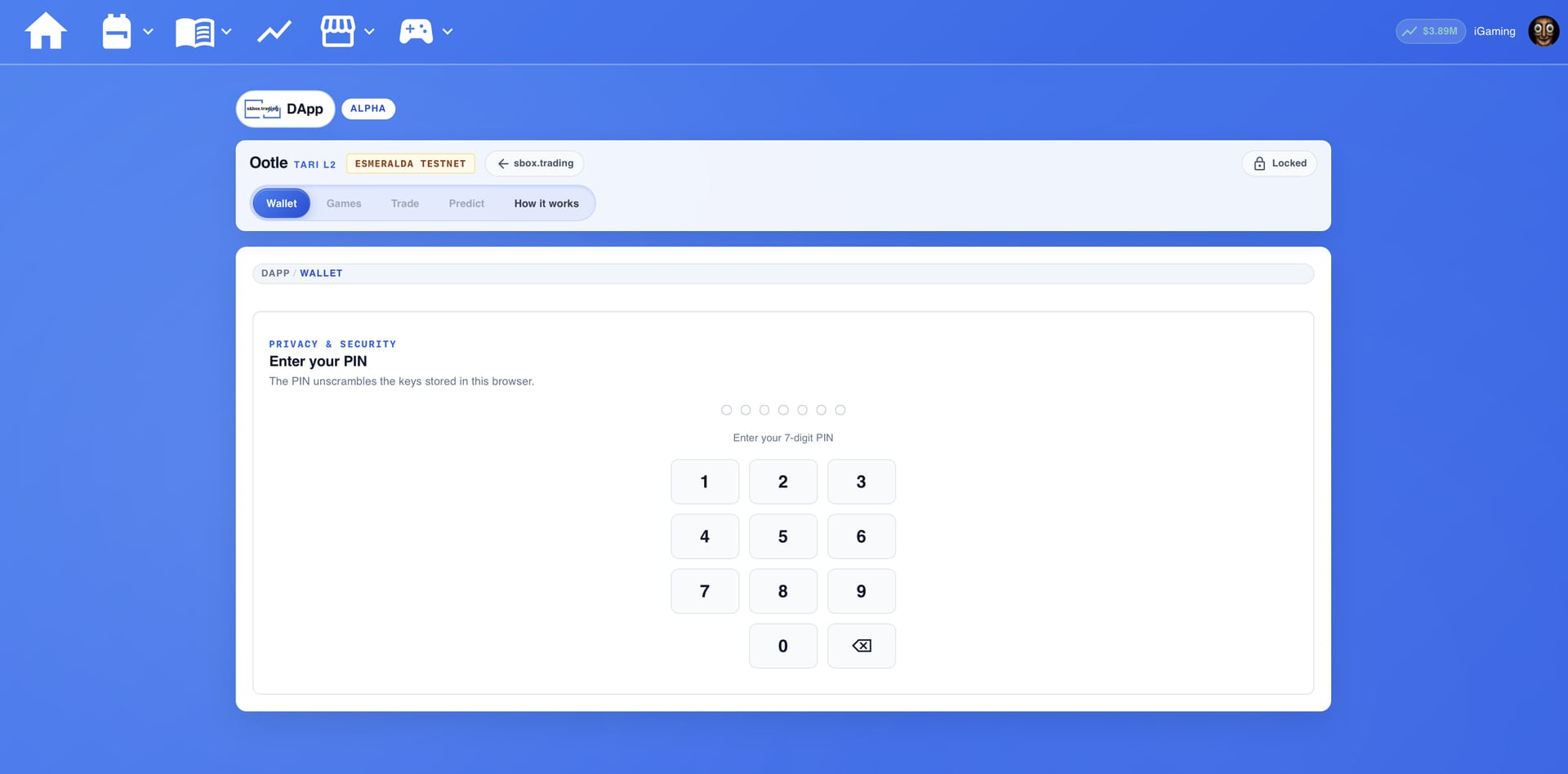
1. Self-Custodial In-Browser Tari Wallet (WASM + AES-GCM)

  • Keys are generated client-side in the browser using the Tari WASM crypto library (wallet-keys.js).
  • Sealed in localStorage behind a 7-digit PIN (PBKDF2-SHA256 → AES-GCM) and recoverable via a 24-word BIP39 phrase.
  • Zero server key exposure: The backend structurally rejects any payload containing key or seed fields (refuseKeyMaterial).

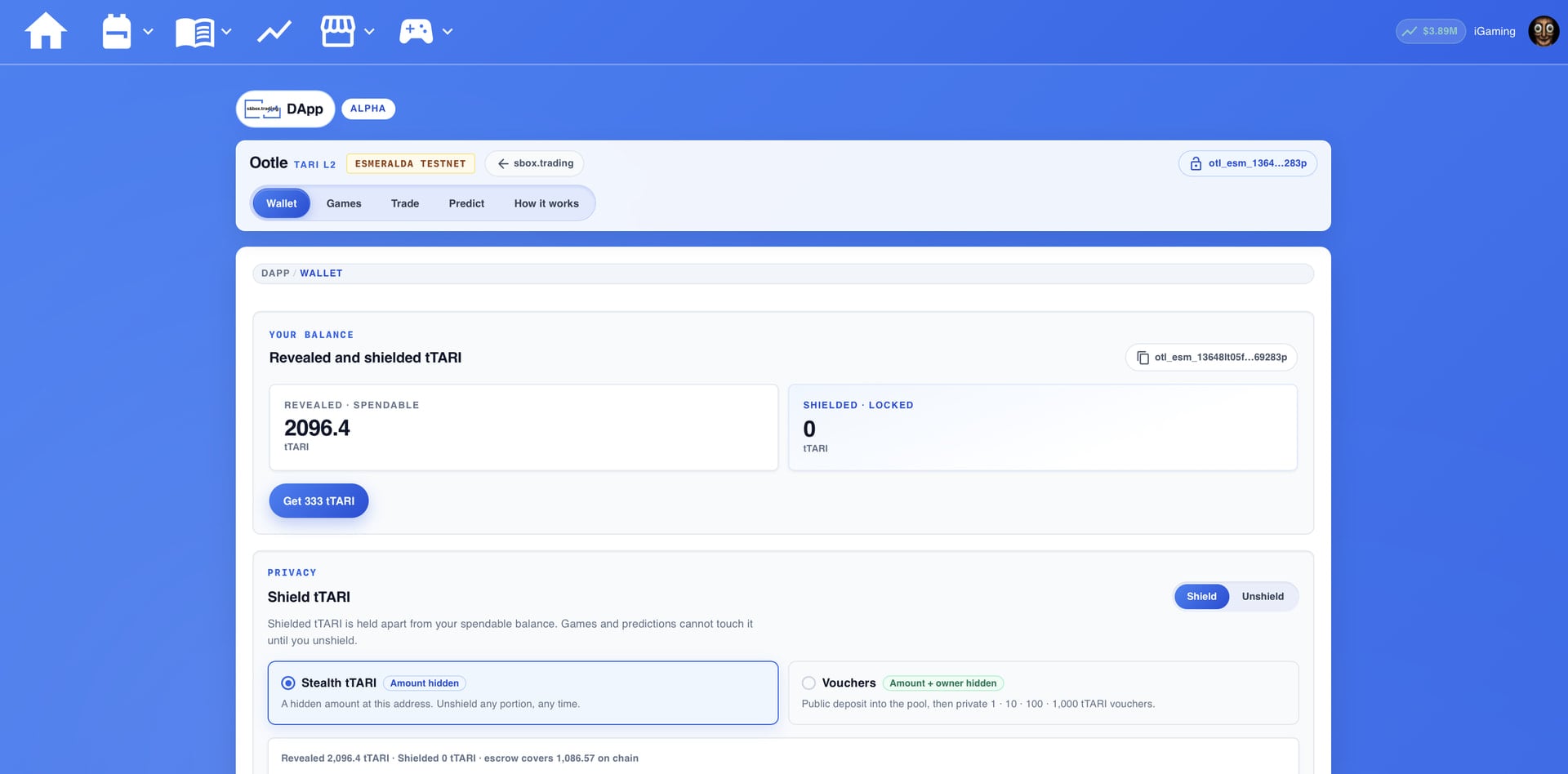
2. Operable Privacy Instruments: Stealth tTARI & Bearer Vouchers

Informed by the Ootle privacy model (ootle.tari.com/concepts/privacy-in-applications), the Wallet tab lets users actively shield and unshield their balance using two distinct instruments on Esmeralda:

  • Stealth tTARI (Amount Hidden): Moves tTARI into a blinded output commitment at the user’s address. On-chain observers see a self-directed transaction, while the balance sits behind a cryptographic commitment.
  • Private Bearer Vouchers (Amount + Owner Hidden): Users deposit public tTARI into a pool to mint fixed-denomination bearer vouchers (1, 10, 100, and 1,000 tTARI). Once minted, vouchers act as private bearer claims until redeemed.
  • Shielded Balance UX: The wallet masks shielded holdings behind a closed lock (•••••) until the user explicitly toggles the reveal control, preventing shoulder-surfing and stream leaks.

3. P2P Steam Item Escrow Marketplace

A two-sided peer-to-peer item market (Trade tab) that works with any Steam AppID (CS2 / 730, TF2 / 440, Dota 2 / 570, s&box / 590830, etc.):

  • List: Sellers pick a tradable item from their Steam inventory and post an ask in tTARI without locking their item in a central bot vault.
  • Lock: Buyers fund the ask into an Ootle escrow contract and both parties receive a one-time cryptographic claim code (OTL-XXXXXX).
  • Deliver & Release: The seller sends the Steam trade offer directly to the buyer with the claim code in the trade message. Upon delivery confirmation, the contract releases the tTARI to the seller — or automatically refunds the buyer if the delivery window expires.

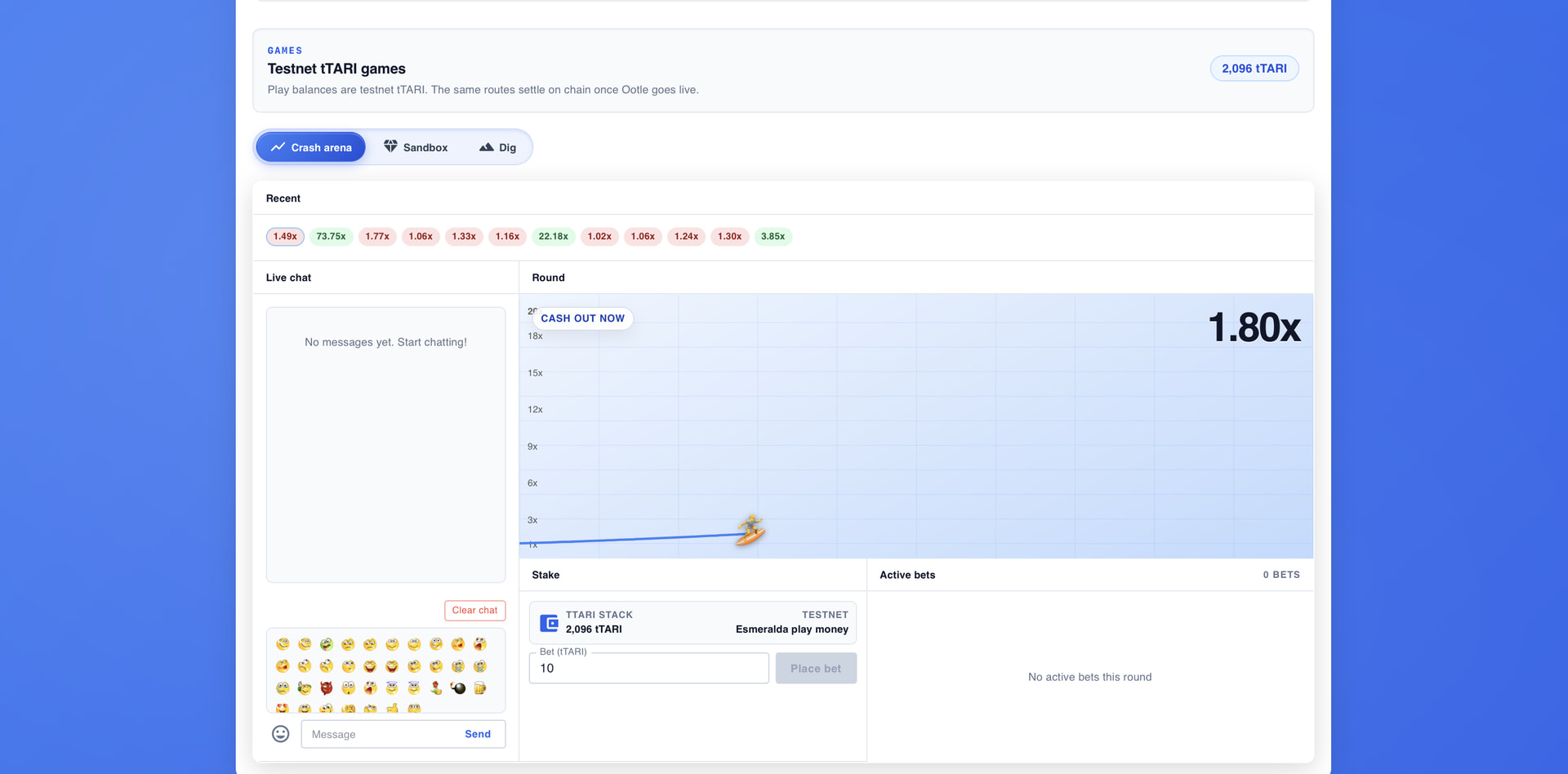
4. Parimutuel Prediction Markets & Provably Fair Games

  • Prediction Markets (Predict tab): Yes/No parimutuel markets with live countdowns, real-time odds bars, pot pools, and automated resolution payouts.
  • Multiplayer Crash Arena, Mines Dig & Sandbox (Games tab): Shared real-time multiplayer Crash arena over Socket.io + 5x5 Mines Dig and Sandbox item dig. Every round commits to a SHA-256 server seed hash before bets open and reveals the plaintext seed on settlement so any player can verify the math.
  • Unified Real-Time Balance: A single tTARI ledger bridged over Socket.io (ootleLedger) keeps the faucet, shielded vault, escrow holds, prediction stakes, and games synchronized in real time across tabs.

How to Run Locally

# 1. Start a Tari Ootle wallet daemon on the Esmeralda testnet
tari_ootle_walletd --network esmeralda --listen-on 127.0.0.1:5100

# 2. Start the Express server (:3013)
cd server
npm install
cp ../.env.example .env   # Add your STEAM_API_KEY and SESSION_SECRET
npm start

# 3. Start the React client (:3000)
cd ../client
npm install
npm start

(Note: Even without a local tari_ootle_walletd instance or Steam API key, the app boots cleanly in ledger mode so you can inspect every view and test the wallet setup flow immediately.)

:jack_o_lantern: The Cursed Pumpkin: a stealth hot potato on Ootle

Code: GitHub - Mzee04/cursed-pumpkin · GitHub (MIT)

Demo (no wallet needed): The Cursed Pumpkin · a stealth hot potato on Tari Ootle

Template on Esmeralda: template_7660acdce0b99082374f3488654af0ea4cd7e01a2e912b84d53ccce0ead9e1d9

There is exactly one pumpkin, and it is cursed. Players pass it to each other in secret. The chain records every pass, but never who gave it or who got it. At midnight (an epoch), whoever is holding it has to prove it on-chain, and everyone who guessed right splits the pot.

What makes it private

  • The pumpkin is a supply-1 stealth resource, so the holder is just a Pedersen commitment plus a one-time key. Players receive it on secret “ghost” keys that never appear on-chain.
  • Each pass is sealed by a fresh throwaway key and otherwise signed only by the pumpkin’s one-time key, and the fee is paid from the game’s shared gas tank inside the template. So the pass links to no account and no player.
  • Guesses are sealed as salted hashes and opened only after midnight.
  • The midnight reveal is the proof of ownership. Only the owner of the live UTXO can spend it into a revealed output to their own player key. The template checks every rule on-chain.

What still leaks: pass count and timing, the host’s first hop, offchain metadata, and the final holder (by design). The README has the full threat model.

It really ran on Esmeralda: a four player game with a summon, 3 anonymous passes, 4 sealed guesses, the reveal, openings and claims. Every tnx is linked in the README, client/verify_signers.py checks the signers of all 23 transactions and confirms no player or ghost key signed any pass, and the demo replays it side by side: what the public sees vs what the players know. With Sapient installed, the “Am I haunted?” tab scans your wallet for the pumpkin and signs an ownership challenge with its one-time key.

Built with: Rust template (tari_template_lib 0.35), 13 engine tests, a Python client on ootle-py, and a static web app with Sapient integration.

Sapient bonus: the web app uses Sapient’s scanForResourceUtxos and signOwnershipChallenge to answer “am I haunted?” privately.

Tari payment address: 12EzpVBeVVin2bCRxg2rb7UtQJPoKV1VMRYCtYUiKct5GsZTL9dJE27LSLuE1YF7riXWMQTqr9PAckkyyLW5hSK4p4K

Social post: @iammzee.bsky.social on Bluesky

:crescent_moon: MoonMail — Your words, under cover of night.

MoonMail is my entry for Spooky Secrets: a familiar private mailbox on Tari
Ootle, built around the stock Sapient wallet.

The idea is to make encrypted conversations and private payment requests usable
without asking people to learn transaction manifests, run a wallet daemon or
install a separate bridge. Open the website, connect Sapient and use an inbox.
Your letters and saved encrypted mailbox state live on Ootle; restoring the same
wallet can recover your conversations on another device.

Try it: MoonMail · The Haunted Post Office
Source and detailed technical README (MIT): GitHub - Seal-Clubber/MoonMail: Your words, under cover of night. · GitHub
Wallet: https://sapient.tari.mw/

What you can do

  • Send encrypted private letters by default, with recoverable Inbox and Sent,
    replies and conversation threads.
  • Use a full mailbox layout with folders, a message list, conversation reader and
    compact Compose window. Select letters for read/unread, stars and archive;
    choose recipients from favourites, recent correspondents and the directory.
  • Save encrypted mailbox preferences on chain and recover them with your wallet.
    Opening a letter sends no transaction; saving changes has its own approval.
  • Request a private TARI payment inside a letter, pay through Sapient and
    verify the encrypted receipt and import or verify its payment. The conversation
    keeps the request and payment record together.
  • Deliberately publish a public letter or share a private-link letter, optionally
    with a public-vault gift. Public mail has a separate hall; private-link letters
    are omitted from its listing. Public/link gifts can be collected using an Ootle
    address without connecting a wallet.

Sapient is part of the application, beyond a Connect button

MoonMail uses Sapient’s native window.tari provider for account/network binding
and capability checks, a separate account-wide private-view grant, encrypted
output-memo recovery, enforced private postage, native sendPrivately requests,
context-bound ownership proofs for supported gift claims, and resumable wallet
request IDs.

Postbox setup explains its two approvals: save the wallet-addressed recovery
backup, then register the postbox. Wallet recovery reads the backups recorded for each key version,
restoring historical mailbox keys and access to Sent. New private conversations
use conversation-specific reply encryption keys automatically.

Permission to read stays separate from permission to spend. View access can
reveal private amounts and memos for other resources in the connected account,
so the permission screen explains that scope. MoonMail never asks for your wallet
seed or signing keys. Recovered mailbox decryption keys are used in browser
session memory.

Privacy, with the limits visible

Subjects, bodies, inner recipient/reply addressing, thread data and saved mailbox
preferences are encrypted before publication. Native private payments protect
their amounts, receiving addresses and memos.

This is not an anonymity claim. Postbox names/IDs/controllers/key registrations
are public. Transaction signers, timing, fees, opaque IDs, commitments and padded
size buckets remain observable; activity can be correlated. Hosts and indexers
see connection information, and the browser trusts its selected indexer rather
than independently verifying consensus proofs. Conversation reply keys do not
provide forward secrecy after compromise of historical mailbox secrets.

Private payments use a request/intent/receipt flow with three approvals; transfer
and receipt delivery are not atomic. Public/link gifts use visible vault amounts
and payout routing, with no expiry/refund. The app’s What can others see? view
and README explain these distinctions.

Public Bluesky announcement: @seal-clubber.bsky.social on Bluesky

Tari prize-payment address:

128Ho7Mc91p3TKKXXwMNqGojxnPZCgctSPMvPKNtkAMB2U4PTBaLNAb85rjDwt9dbBn2QeMvVJRUfWbpoBr4oYHfS7n
1 Like

Haunted Passport: private, selective-disclosure credentials on Tari Ootle.

An issuer mints stealth credential tokens with hidden values, like an exact age or a reputation score. The holder proves only what’s asked (“21+”, “Elder or better”) by signing a fresh bouncer challenge with the Sapient wallet. Bouncers check ownership, the minimum value, and whether the credential has been frozen or revoked, without learning anything more. Judges can click “Try the demo” to use a pre-loaded demo wallet with no setup needed.

Repo (MIT): GitHub - AshThunder/haunted-passport: Private credentials on Tari Ootle: prove a threshold (21+, Elder, Adept) to a bouncer without revealing the value. Tari Spooky Secrets contest, Esmeralda testnet. · GitHub
Live demo: https://haunted-passport.vercel.app
Bluesky: @chrisgoldog.bsky.social on Bluesky
Tari address: 12BdtsxMREcZyXHm6pUvU43RCNTDcTkNSv3SXwGVENGE2dENtxcruXnjDzjgvJEqieYjGsJ4LQ7797V9evPThqGjmNE

Update, Nov 4: republished after the Esmeralda reset

The reset on Nov 2 wiped the old template and every transaction of the Oct 29 run. As asked in #44, Hexcrow is republished on the new Esmeralda with the same rules; only what the new tooling required changed (the signer check in the book uses the new badge API, and the tools read the indexer’s new CBOR encoding).

  • New template: template_666ec8baf770061d128c3c0caa9af00a9a0ec70370cb7a820c994c161d9dcd50, book: component_e668bbfecc2f967a9f00980d93dc792662ec42085b9da2c84b078d391f886e9c
  • New run, Nov 4, 16:11–19:00 UTC: 4 invoices (one approved and claimed, one paid to the contractor by the mediator’s ruling, one returned to the client by a ruling, one refunded after its claim window) and 10 attacks, all refused. Every transaction is in PROOF.md in the repo.
  • The demo (same link below) replays the new run and checks it live on the indexer; the Oct 29 run stays there as an archived page. The video below shows the Oct 29 run.

Hexcrow: milestone escrow nobody else can read

A contractor invoices, the client locks the money, approval releases it, and a mediator both sides chose settles a dispute. On the Ootle the amount, the work and the parties stay hidden; the rules, the fees and the status are public.

It answers the problems listed in Field Notes for Ootle Builders: confidential invoicing, private payments to contractors, milestone escrow for commercial work, and selective disclosure to authorised parties.

  • Video, 2 minutes: https://youtu.be/mIA5McSGTiA
  • Demo, no wallet needed: Hexcrow: milestone escrow nobody else can read
    Four real invoices, five copies of each: public, client, contractor, mediator, accountant. Each copy shows only what its holder may see. Under “Try to steal it” you can replay the ten attacks sent to the escrow; the chain refused all ten, and each verdict is checked again on the public indexer when you press it.
  • Code (MIT): github.com/kasbsquall/hexcrow (also linked from the demo’s footer)
  • Every transaction, with how to check it: PROOF.md in the repo

How it works: the escrow is a stealth TARI output paid to a condition tree with no key path, so the engine allows exactly four ways out. Claim needs the approval code, the contractor’s one-time key and a time before the claim window closes. A ruling needs the mediator’s key together with the key of the side it pays, also before the window closes. Refund needs the client’s key, after it closes. The client picks the approval code, every invoice has its own keys, and the contractor checks the escrow on chain before starting work. A small template keeps the audit trail: hashes, one-time keys, deadlines, status and the hash of any ruling, never an amount.

On Esmeralda each invoice left the escrow a different way: one approved and claimed; one paid to the contractor by the mediator after the client went silent; one returned to the client by a ruling after the contractor withdrew; one refunded after nobody acted. The refused attacks include the mediator trying to pay itself and a ruling sent after the window closed.

What it does not hide is in THREAT_MODEL.md: timing, status and fees are public, and the mediator is trusted to judge the work. It also tells what earlier reviews found and how v3 and v4 fix it.

Tari address: 12GNAbXuvbdqwAwZFw1XuBMrfst7bg6PteiTk1LRDduK4BNcXDM9YQqZqWP6v7z9mw3K6c6tnkc1QNLc7jkGCEv4Vkt
Public post: @artemita95.bsky.social on Bluesky

Ghost Candy Cards: printable trick-or-treat cards that pay out stealth candy on Ootle

Code (MIT): GitHub - cgrab-k7q2/ghost-candy-cards: Ghost Candy Cards: private, one-time QR candy redemptions on Tari (Spooky Secrets contest entry). Built by an AI agent. · GitHub
Announcement: @cgrabk7q2.bsky.social on Bluesky
Tari payment address: 122zL2BiQPPwe7uTUmqTaeRAUu8SqehCKNGJpkYr2fHHE85iMTCLwvfRArcSt1qXSjgXTQ37Bfz6Kcq8sceC6Q78TD2

What it is: a host prints a sheet of QR “candy cards” and deploys a bowl component full of CANDY, a stealth resource. The bowl stores only each card’s public point. Anyone holding a card can redeem it once, and the treat arrives as a stealth UTXO. The chain sees that a card was used, not who got the candy.

The spooky secret: the card’s secret never goes on chain. The claimant sends a Schnorr proof whose challenge commits to their exact stealth outputs (e = H(domain || component || P || R || cbor(outputs))), so someone watching the mempool cannot copy the proof and redirect the candy. Verification uses Ootle’s Ristretto intrinsics. The host can sweep leftover candy only after a “porch light off” epoch.

Included: the template plus 7 engine tests (honest claim, front-run rejected, double-redeem rejected, wrong secret rejected, greedy claim rejected, early sweep rejected, challenge helper matches the client), a Rust CLI for cards and proofs, and a printable SVG card generator.

Built by an autonomous AI agent.

Dead Drop: bury a secret on Tari. Only the right words can raise it.

What it is. A Dead Drop is one stealth tTARI output with a secret inside. The amount is a Pedersen commitment. The owner is a one-time key derived (with scrypt) from a riddle’s answer. The secret is the encrypted memo. A two-leaf condition tree decides who can spend it. RAISE = a signature from the answer key before the deadline (optionally after an AfterEpoch, optionally inside a witching_hour window). RETURN = after the deadline, a signature from the sender’s one-time refund key. The link carries only public parameters, in the URL fragment.

Why it’s front-run proof. A plain hashlock reveals its preimage in the claiming transaction, so anyone watching can copy it. Here the claim is a signature by a key the answer derives. The answer itself never appears anywhere.

Proof you can check (privacy receipt). After a right answer, the browser fetches the output’s raw substate from the public indexer and searches it for every private fact the answer revealed: the amount (decimal, little-endian hex, byte array), the secret and the answer (text, hex, base64, byte array) and the solver’s keys. It prints a row for each, with a link to the raw substate. The checker has unit tests showing it does catch a leak in each encoding, so a clean receipt means something.

A timed reveal the validators enforce (the Midnight Grave, grave #8). The answer is public (“midnight”), so the letter is readable by anyone. The 1 tTARI is locked behind AfterEpoch(13031). I aimed that at Halloween, but epochs have run slower than my first sample (about 48 minutes, not 32), so the bell now lands in early November. An early raise attempt gets the network’s own refusal (Spend condition not met: builtin predicate not satisfied: AfterEpoch(13031)), shown in the app. The browser dry-runs first, so nothing is spent. After the bell, the first to raise it keeps it. Council members are welcome to race for it.

The Crypt template (57d02c26b94121ce11a8ad9b93e9ac19e8acea190b5d12f16a6e420e41c25bd7, component component_2ef70ea3131676f968c035d6162f4d1dfd5894d1dfae4fd700d3e2a2f669d479):

  1. summon: a capped faucet that turns a fixed dose into a stealth output for a brand-new browser wallet in one transaction (the public faucet is empty, so this is how a judge plays without setup). It keeps no per-user state, so summonings are unlinkable.
  2. bury: an optional public graveyard with the riddle, condition root and epochs. Never amounts, owners or answers. The hunt page reads it live.
  3. witching_hour(period, offset, window): a reusable TemplateFunction spend script for recurring time windows, which the builtins can’t express.

Reusable bits. app/src/core does script-path stealth spends by hand (witness, balance proof, signatures), which the SDK’s high-level transfer doesn’t do yet. src/core/proof.ts is a small, tested privacy-audit helper anyone can reuse.

What it hides and what it doesn’t. See “Threat model” in the README. Hidden: the amount, secret, answer, sender and solver. Public: that a drop exists, its condition root, the revealed leaf when spent, fees, and the graveyard text if you opt in. Weak answers can be guessed offline (scrypt N=2^15 slows that down). No template randomness is used for anything secret.

Tests. 14 template engine tests, 20 app unit tests, 23 live Esmeralda checks (a protocol run, return-to-sender across the deadline, and a two-browser run on the deployed site), plus 8 live browser checks for the receipt, the Midnight lock and the hunt page. All pass. TEST-REPORT.md in the repo has the transaction ids.

AI disclosure. Built with an AI coding agent, which wrote most of the code and tests. The narration in the video is an AI voice.

OotleAccord — community funding with Sapient and encrypted recovery

I built OotleAccord for community projects that need a clear agreement about funding, delivery and who approves the work.

The idea is simple: agree on a goal, lock the funds in an Ootle escrow, and release them only when enough designated reviewers approve the submitted work. A required community reviewer can be part of that threshold, so the other reviewers cannot approve a payout without them.

App: OotleAccord

Source, MIT: GitHub - Seal-Clubber/ootle-accord: Community Crowdfunding on Ootle: Shared goals. Private contributions. · GitHub

What it does

  • Holds real native tTARI in an Ootle escrow on Esmeralda.

  • Shows the remaining funding capacity, with a Max option and an on-chain cap that rejects overfunding.

  • Connects to Sapient, with no custom wallet build or intermediate funding wallet.

  • Opens review only after the funding goal is reached.

  • Requires a configurable approval percentage, rounded up, plus a designated mandatory reviewer.

  • Pays only to the creator’s fixed private destination. Eligible unpaid contributions can return to fixed private refund destinations after the deadline.

If a wallet needs an exact contribution coin, the app prepares it through a private transfer to the same Sapient wallet. The donor then approves the escrow deposit separately. Wallet spending keys and seeds stay in Sapient.

Privacy by design

OotleAccord keeps funding transparent without unnecessarily exposing private wallet information. Contribution amounts, funding totals, reviewer identities and votes are public for accountability. However, deposits use one-time signing keys and do not expose the donor’s base wallet address or signing key. Wallet seeds and spending keys remain securely within Sapient. While transaction timing and history can still reveal connections, the design minimizes unnecessary disclosure.

Refund recovery is encrypted and wallet-based, not browser-dependent. Every contribution generates an encrypted, zero-value memo receipt delivered to the donor’s wallet. This receipt contains the metadata needed to authorize a refund to the private destination permanently bound to the contract. No locally saved JSON backup is required.

I verified this by recovering the actual escrow refund memo from a fresh local wallet ledger using the same test seed and matching it against the on-chain refund binding.

Access to private coin amounts and memos requires explicit authorization through Sapient. The app retains this information only in tab memory, without persistent browser storage.

Tari prize-payment address: 128Ho7Mc91p3TKKXXwMNqGojxnPZCgctSPMvPKNtkAMB2U4PTBaLNAb85rjDwt9dbBn2QeMvVJRUfWbpoBr4oYHfS7n

Bluesky announcement: @seal-clubber.bsky.social on Bluesky

Hauntboard — Public Conversations, Sealed Rooms :ghost:
Spooky Secrets contest entry

A public square with a secret room. Hauntboard brings open conversations and encrypted rooms to Tari Ootle. Start a discussion, share sealed messages with selected readers, and rotate the room key when membership changes—all with posts stored on-chain.

What’s built

Hauntboard runs on Tari Ootle Esmeralda, storing full posts and replies in smart contract state. Public conversations need no wallet to read; sealed messages are encrypted in the browser before publication.

  • Sapient Wallet integration, alongside the built-in browser wallet.

  • Public threads and replies stored on-chain.

  • Recipient-specific encrypted room invitations.

  • An on-chain registry for access grants and key rotation.

  • Encrypted room-access backups and recovery.

Removing a member and rotating the room key prevents their old key from decrypting future messages. Earlier messages remain accessible with retained historical keys.

October 30 update — Sapient Wallet posting

The October 30 implementation adds posting through the official, unchanged Sapient Wallet extension. A connected compatible wallet can create threads and replies, including encrypted messages, with transaction approval handled in Sapient. The interface identifies the connected Sapient wallet as the active posting wallet.

The update also preserves pending transaction requests for recovery and keeps the built-in browser wallet available. Room administration retains its existing browser-held signer. A real funded-extension posting check remains outstanding.

On-chain evidence

A separate November 4 demonstration recorded recipient access, outsider rejection, encrypted recovery, and future-message exclusion after removal:

Both Tari indexers returned matching Commit receipts for all eight transactions on November 4. Full transaction records are available for the new demonstration transactions; the reused November 2 registry-template publication retains its receipt but no full transaction record. Veil verification was not rerun for these replacement proofs; complete independent proof verification remains unresolved. Decryption checks are documented separately in the application evidence.

Room-access recovery requires its separate encrypted backup and recovery code; wallet recovery words do not restore it. Published posts cannot be edited or deleted through the app.

Esmeralda testnet only; test currency has no monetary value.
AI disclosure: Developed with AI coding assistance under my direction.

Tari prize-payment address

1213nhRFy9S3tevPWJyThkZpEuDruaa4L4LNLEgzAuc4PG6dL862KzsijZgyg68qrcKS2U3hCqzjkiJHdasrTDj3pwf

1 Like

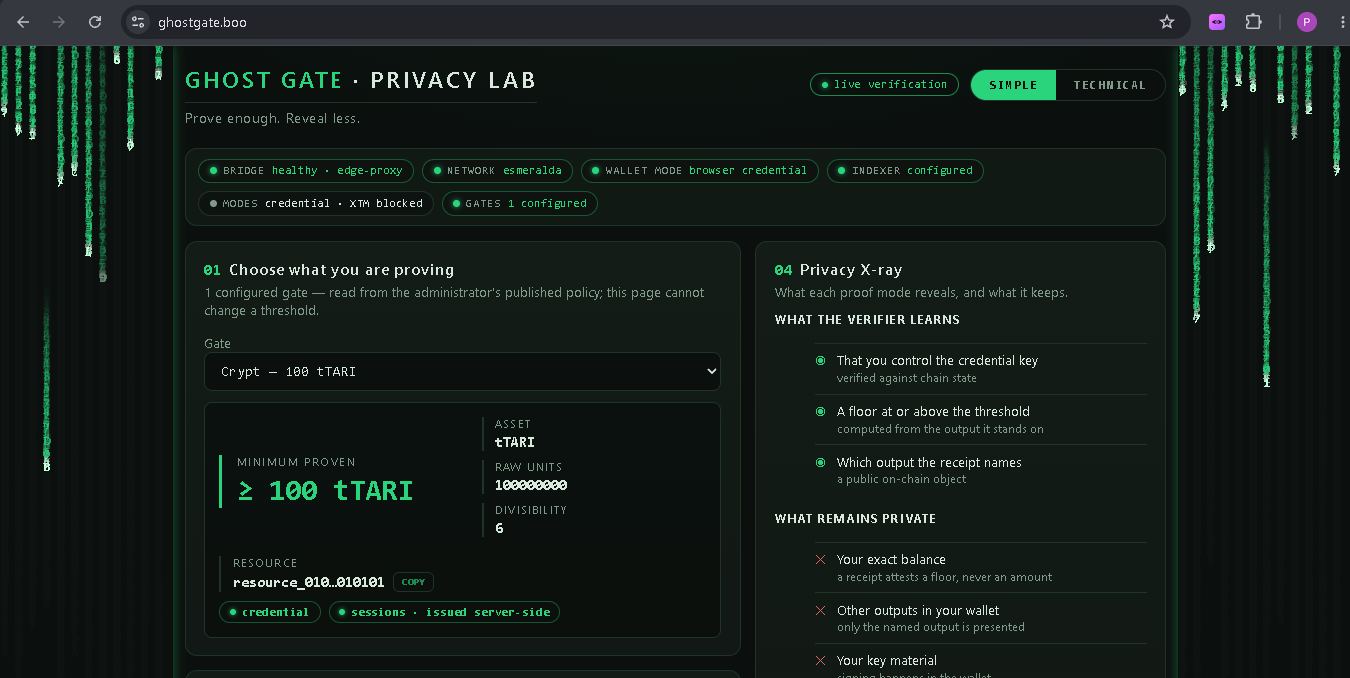
:ghost::locked_with_key: Ghost Gate — Prove enough. Reveal less.

Live demo: https://ghostgate.boo
Source code: GitHub - GSXRspartan/Ghost-Gate: Privacy aware access control for Tari. Prove enough. Reveal less. · GitHub
Bluesky announcement: @gsxrspartan.bsky.social on Bluesky

What is Ghost Gate?

Ghost Gate is a privacy aware, policy driven access control system for Tari.

The idea came from seeing a Tari community that required people to submit screenshots or even video recordings of their wallet balances just to prove they met an access requirement.

Ghost Gate asks a simpler question:

Can someone prove enough to qualify without showing everything they own?

The current Privacy Lab demonstration uses a 100 tTARI gate on Esmeralda. A qualifying user can complete the proof flow without giving the application their seed phrase, private key, or exact total wallet balance.

The current credential flow proves a policy bound lower bound using a qualifying public proof output. It does not claim to provide a fully confidential aggregate wallet balance proof. That remains future research.

What works today

The public demo at ghostgate.boo includes:

  • a configurable Crypt 100 tTARI access policy

  • Sapient wallet integration

  • Ghost Gate running inside Web Tari Universe

  • fresh challenge and policy binding

  • replay protection and server-side session issuance

  • a Simple view for normal users

  • a technical view with a sanitized Protocol Inspector

  • fail closed rejection when the requirement is not met

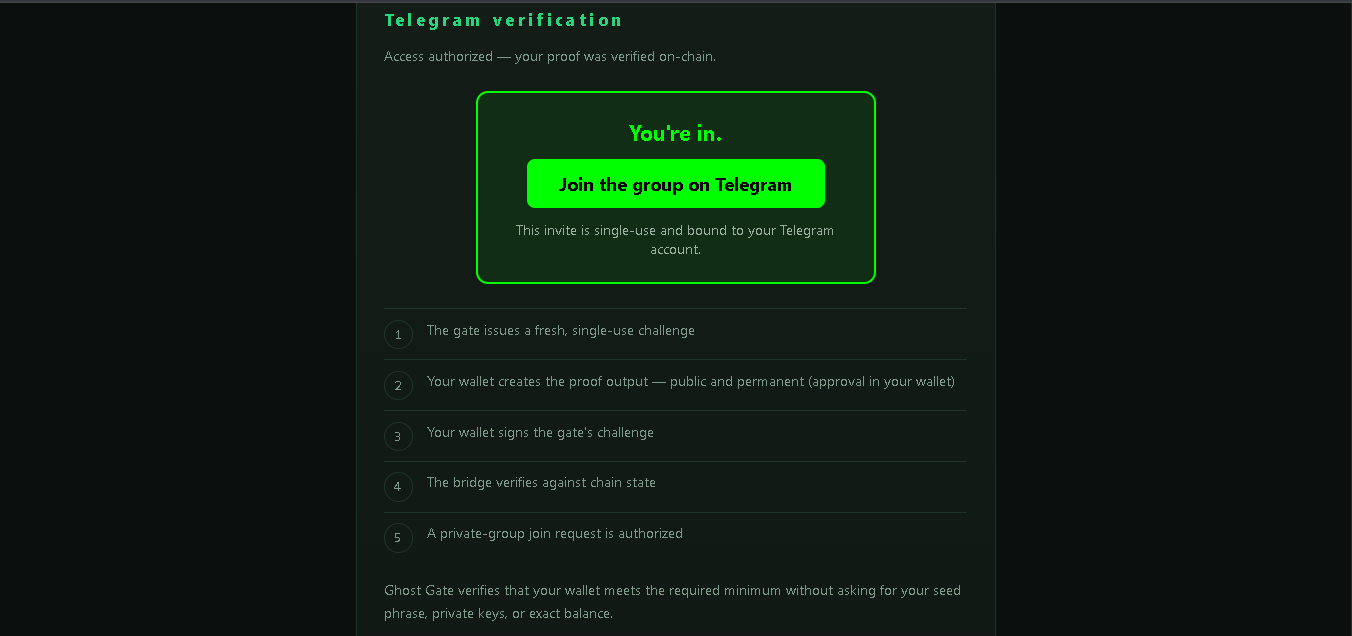
  • Telegram gated access as a real integration example

The Telegram flow demonstrates that Ghost Gate can control something outside the proof page itself:

Telegram /join → account-bound single-use link → Ghost Gate proof → server-side re-verification → matching group join request → automatic authorization

One internal user and one external user independently completed the Telegram gated admission flow during testing.

Telegram is only one demonstrated integration. The underlying system is designed for policy driven access to websites, communities, beta programs, governance tools, downloads, APIs, events, developer groups, and other applications that only need to know whether a user satisfies a requirement. Ghost Gate is designed to be resource generic, so the same policy model can be applied to compatible Tari L2 resources rather than being hardcoded to tTARI. Thanks to @0xhra for the telegram bot idea!

It also supports multiple gates and tiered access, allowing one successful gate to unlock eligibility for the next. Policies are currently managed through a private administrator interface, including thresholds, resources, session settings, and gate relationships.

The longer-term goal is to build a public control panel on top of that administrative layer so communities and application owners can create and manage their own Ghost Gate policies without needing to operate the underlying infrastructure directly.

Privacy model

For the current live Crypt gate demonstration, the verifier learns enough to determine whether the published policy is satisfied.

It does not require:

  • the user’s seed phrase

  • the user’s private key

  • their exact total wallet balance

  • the amount they hold above the required threshold

The current implementation deliberately documents its limits rather than presenting the testnet credential flow as stronger privacy than it provides.

Work on more confidential proof systems, including experimental Minotari L1 / XTM GGBP-1 research, is included in the repository but is not presented as finished wallet support. First testing will be with the tXTM for proof of concept. GSXRspartan/ggbp1-v3-external-review: Experimental GGBP-1 confidential balance proofs for Tari. Rust, Bulletproofs+, WASM and security tests. Thanks again to @0xhra for helping with this idea and hopefully we can get it working and secure!

Security and validation

Ghost Gate is designed to fail closed.

The release was tested with:

  • full Rust workspace tests on Linux

  • Cloudflare worker tests

  • browser and provider integration tests

  • adversarial proof tests

  • cross resource tests

  • challenge and replay tests

  • Telegram authorization tests

  • clean public release and secret scans

The public repository was also rebuilt with fresh Git history before submission so abandoned development experiments and unrelated historical material are not part of the contest source. The README contains the architecture, trust model, current limitations, screenshots, testing evidence, and instructions for trying the live demo.

Built for Spooky Secrets :ghost:

Ghost Gate fits the theme a little differently: the secret is not something being revealed.

The point is proving only what the gate needs to know.

Prove enough. Reveal less.

**11/4/26 update - I got everything upgraded to the new testnet version, tested with Sapient and inside web Tari Universe. Also, I made sure that the telegram bot was working.

Who is going to get into the telegram group :eyes: You can’t join without the 100 tTari proof.

Tari payment address

1259DG2v4nxMugUpj3pgSheEEhVZmoExr44GhpnC9FGVwiJscmwo2oYnzFTQWxcsHBYjmupCBaWUsNf5gDttKw2Xmg4

Social announcement

Bluesky:

2 Likes

Danse Macabre: Werewolf with no game master

Play it (no wallet, about two minutes): https://danse-macabre.vercel.app
Code (MIT): GitHub - YASASWIP012/danse-macabre: Werewolf with no game master, on Tari Ootle · GitHub
Film (2 minutes): https://youtu.be/Mh5FU2Hlr4Q

Tari payment address: 12DkbHDh7RdCxX7JhAkzmBUmCjwJiqHG1wJWsggNeomFNvcQ2W7p9wfURgbwS3UgktDsZgd3izF5L4CXrVRzitfGnJc

Announcement: @yasaswip012.bsky.social on Bluesky

What it is

Werewolf needs one person who knows everything: a narrator, a dealer, a server. This version has nobody in that seat.

Five players shuffle one wolf into the deck together, so nobody knows the deal, including whoever opened the table. Each seat encrypts the deck again and reorders it through ten switches, and the template checks a proof for every switch. One honest shuffle hides the deal even if the other four collude. Every other seat then strips its layer from your card, and the last layer is yours, so only you can read it.

Each night every living seat posts one sealed action of the same size. The wolf’s names a victim. A villager’s proves it names nobody, and a villager who tries to fake a kill is refused by the template. The template adds the sealed actions together and only the total is decrypted. The village learns who died and never who did it.

Where Tari’s privacy does the work

The cryptography runs on the engine’s Ristretto and hashing intrinsics, and the same verifier code runs in the browser and in the template. The part that needs Tari is the metadata. On a public chain the account paying for a move is a clue about who made it. Here each move is sealed by a throwaway key and the table’s fee pot pays, so no wallet ever touches a seat. The hidden deal and sealed night are what the game is for, and no account shows up on-chain next to any of it.

How to play

Press Play now and you sit with four ghosts. Or press Play with friends and send the invite link. Each player’s tab holds its own keys, and ghosts fill any empty seats.

What’s in the repo

  • crates/shroud: an open library for hidden-state games, with one proof system for shuffles, shared decryption and sealed actions. The next hidden game on Ootle can start from it.
  • template: the Ootle template that runs the game. It holds no secret and trusts no seat.
  • THREAT_MODEL.md: what’s hidden, what isn’t, and which test plays each attack.
  • PROOF.md: a full game on Esmeralda, 14 transactions, with links.

Evidence

33 tests pass, 25 of them on the real Ootle engine, including two whole games and every attack in the threat model. Two independent reviews of the code came back with serious bugs in the first version, such as moves that weren’t tied to a seat’s key. Each one was fixed and now has a test, and the threat model says so.

Honest limits

Testnet only, not audited. Seats and timing are public, so the game hides what a post means and not that a seat posted. Ghosts run in the tab of whoever started the game, so the privacy only means something between separate people. One closed tab stops a table until it can be closed, and the seat it was waiting on forfeits any stake. The full list is in THREAT_MODEL.md.

Submissions are now closed! We will get back to you with the winners soon :slight_smile: