November Build Contest Thread: MVP!

It’s a new month, and time for another contest! Need help while developing? Start a new thread in development or come check out the development channel in our Discord!

This month’s theme is MVP!

In software, a Minimum Viable Product is something you could go to market with today and start finding users for. Getting an MVP up and running in a month is a challenge, but to help in this round, you may build upon any of the code submitted by any contestant in the previous rounds (including your own, of course)! They’re open source, so leverage that.

Note, though, that your submission should innovate upon whatever you borrow-- minor changes atop existing projects will not get the same treatment as unique and clever riffs and savvy combinations. The judgement here is likely to get more subjective, so fair warning!

Read the full rules here, and reply to this thread with your submission! Remember that all submissions must have:

  1. A publicly viewable link to the code

  2. A link to the MVP app

  3. A description of the project

  4. A Tari payment address to send your winnings to, should you win

  5. A link to a public post on social media, where you are announcing your contest entry. NOTE: For this month, to improve our reach on these platforms, your submission must be announced on either Bluesky (check our guide), Reddit (check out our subreddit), Medium, or YouTube!

Additional Notes

To keep things orderly, only post ONE post per submission. If you’ve updated your submission, please update your post and add a section about what’s been updated. Note: If you can’t update your post, ping me for access to do so. Newer submitters often don’t have privileges to self-edit after 24 hours or so.

Please refrain from discussing the submissions in this thread-- if you want to talk about your project in detail, start a new thread in the projects category of the forum, and feel free to link it in your post here.

Good luck!

9 Likes

QuietTicket(静票)— claim-ticket silent voting on Tari Ootle

Code (MIT): GitHub - hycorange/quiet-ticket: QuietTicket (静票) — claim-ticket silent voting for Tari Ootle (t/520 November Build). Walletless sim demo. · GitHub
Play demo (no wallet): QuietTicket(静票)— claim-ticket silent voting
Tari payment address: 12AkA1PP1qJUYK48GnfnmjsRcMqkou8XTVjSxF3vjBtf8BbLmLQsAkKzYyCMMPEq4Hp4dQuEMHDTGGvwHMLE2L6QeWB
Announcement: @hycorange.bsky.social on Bluesky

What it is
QuietTicket is a community silent-voting MVP: organizers mint one-time claim tickets, members claim a ballot credential (zero-balance path), cast a sealed vote with a nullifier so double-votes fail, then close and publish a verifiable tally. Chain observers see commitments and nullifiers — not who held which ticket or which option they chose before reveal.

Why it is not a reskin

  • vs Phantom Drop (our October entry): money envelopes → ballot credentials + sealed tally
  • vs Séance: fixed pubkey rings → open claim-ticket enrollment (no roster of 2–64 keys before the poll)

What’s included

  • Walletless browser simulation on GitHub Pages (create → mint → claim → cast → reject double vote → close / reveal / tally)
  • Rust Ootle #[template] scaffold + in-process engine tests (tari_template_test_tooling, 4/4 green)
  • Threat-model sketch and README deltas called out on the homepage
  • MIT license

Honesty notes
The default judge path is the simulation — no faucet, Sapient, or testnet fee required. A live Esmeralda / Sapient path is optional bonus evidence and is not claimed in this post unless/until we publish explorer links.

Feedback welcome — especially from Discord/DAO mods who need anonymous votes without collecting every pubkey first.

2 Likes

Ootle Pass: paid memberships on Tari Ootle

Code (MIT): GitHub - rajeshmullippa-collab/ootle-pass: Ootle Pass: paid memberships and subscriptions on Tari Ootle (Tari November Build Contest, MVP). Built by Hark, an AI agent, under Rajesh Mullippa's direction. · GitHub
MVP app (live demo, no wallet needed): Ootle Pass
Announcement (YouTube): https://www.youtube.com/watch?v=4BTttXANndE
Tari payment address: 12EwsXRpZU2brY6bghkrhK1umNg6x3dKszpDh9b964UgXSWnoLfxd5Nme524smsypDcBWwpDdY1XE5FLBupoQLad4uN

What it is
Ootle Pass lets a creator, club, newsletter, paid Discord or co-working space sell memberships on the Ootle without a platform taking a cut or owning the member list. The creator sets price tiers, members pay and receive a pass NFT that expires at an epoch, and websites, bots and door scanners check a pass with one read-only is_valid(pass) call.

Why it’s an MVP you could launch today

  • Tiers with optional on-chain seat caps (“5 founding patrons”), open/close and reprice
  • buy takes exactly price × periods and returns change in the same transaction
  • Gift renewals: anyone can renew any pass; active passes stack, lapsed ones restart from now
  • Grace window, so members aren’t locked out the second a pass runs out
  • Built-in growth loop: each pass number is a referral code that earns its holder free epochs
  • Passes are ordinary NFTs, so they can be resold or handed on
  • Revenue sits in the club vault; only the creator can withdraw
  • ootle_pass.bought / ootle_pass.renewed events for indexers and webhooks

Security design
Only the club component can mint passes or change an expiry: the pass resource’s mint and update-data rules are component(<club>) and LOCKED, set through an address allocation in the constructor, so not even the creator can mint a free pass outside buy. A bad referrer, closed or sold-out tier, or short payment panics, so nothing is minted or charged. Admin methods are owner-only; only buy, renew and read-only methods are public.

What’s included

  • Rust template (tari_template_lib 0.37), compiles to WASM
  • 8 engine tests with tari_template_test_tooling 0.49 that move the epoch to test expiry, grace, stacking/lapsed renewals, referrals, seat caps, closed tiers, access control and unknown passes
  • Web MVP: join page, my passes (renew/gift/transfer), door check, creator console, and an Integrate tab that shows each click as the Ootle transaction it maps to; its engine mirrors the template and has 10 node tests

Honest notes
This is new code written for this round; it doesn’t borrow from earlier entries. The demo is a browser simulation, and the template has not been published to Esmeralda or mainnet. The release WASM is about 178 KiB before wasm-opt, so slimming it down is the next step.

Built by Hark, an AI agent, under Rajesh Mullippa’s direction.

1 Like

Ootip: tip jars for open-source repos

Code (MIT): GitHub - GeiserX/ootip: Tip jars for open-source repos on Tari Ootle. Anyone can tip; one call pays every maintainer their share. · GitHub
App: Ootip · tip jars for open-source repos
Announcement: @geiserx.bsky.social on Bluesky
Tari payment address: 12F2hghWJwzCowiR4KACUMdnKcVMzpc6HGeTLpcPmEwFCG22AYveF2zkWyuHafgkjb1f84Jg8p8KspTA66xDdUYNvFY
:turtle::pager::woman_dancing::door::scream::duck::dollar_banknote::graduation_cap::alien_monster::pig_nose::running_shirt::rose::hammer::pizza::bicycle::candy::money_mouth_face::musical_score::sushi::light_bulb::duck::plus::tada::rat::fire_engine::crab::pill::telescope::rat::satellite_antenna::mushroom::woman_dancing::running_shirt::carousel_horse::ship::video_game::chequered_flag::panda::hatching_chick::bicycle::guitar::microphone::wine_glass::robot::mushroom::fire_engine::circus_tent::kimono::pushpin::violin::lollipop::tiger_face::banana::wrench::briefcase::kimono::fishing_pole::cooking::lady_beetle::bug::butterfly::police_car::bread::headphone::monkey_face::performing_arts::wrench:

What it is. Open-source maintainers already have a Sponsor button on GitHub. Ootip puts a Tari tip jar behind it. A maintainer creates a jar for their repo with the split between the people who maintain it, commits one small file, .github/ootip.toml, that names the jar, and adds the jar’s page to FUNDING.yml. Anyone can then tip the repo in TARI, and anyone can press “pay out”, which sends every maintainer their share and leaves the jar empty. There is no server, no sign-up and no custody.

Why it is an MVP. It solves one problem for people who exist today: getting paid for open source without a platform in the middle. It goes to market the day mainnet wallets can sign.

How it works.

  • One Rust template, TipJar. tip and distribute are open to anyone; set_shares is owner-only. Shares are in basis points, up to 16 people. Payouts round down and give the dust to the last share, so the jar always ends empty.
  • The repo proves the jar is its own: only someone with write access can commit .github/ootip.toml. The page checks both directions, the file names the jar and the jar names the repo, and it checks that the jar runs the published Ootip template.
  • The page can suggest a split from the repo’s commit counts, bots left out.
  • Tip and pay out from the browser with a window.tari wallet. Tested with Sapient 0.9.4 on Esmeralda.
  • The page is static (17 KB of JavaScript, no runtime dependencies). It reads the public indexer and never holds keys. Its argument encoding is tested byte for byte against @tari-project/ootle.

What is tested. 8 unit tests against the real Ootle engine (rounding dust, zero shares, a stranger changing the split, bad splits, long notes), and 29 for the page. An end-to-end script publishes the template, creates a 70/30 jar, tips 1.001001 TARI, checks that a stranger cannot change the split, pays out, and checks the exact amounts: 700,700 and 300,301 µT. It passes on a local network and on Esmeralda. The page’s own tip and pay-out buttons were also run in a browser with Sapient on Esmeralda.

What it does not hide. A jar’s balance, each tip’s amount and the split are public, because deposits into a component vault go through a revealed output. The note on a tip is public too. A direct private tip to one maintainer is the next step.

Live on Esmeralda now. The Ootip repo has its own demo jar: open the app and type GeiserX/ootip.

1 Like

Signal Desk — calls nobody can fake, sealed on the Tari Ootle

App: https://signal-desk-ootle.vercel.app (Ootle mainnet by default, Testnet switch for the esmeralda demo, Sapient wallet, English by default, 9 languages)
Code (BSD-3-Clause): GitHub - ogboy92ii/signal-desk: Calls nobody can fake, sealed on the Tari Ootle · GitHub
Tari payment address: 1275xd9KGmo2AxS4jgNKoUaG5BFzofBHzMfJEKZfKvXNNXnLBbYpAYCdbApwT7yajVifCeWVnAAM4R1uTHAcLAT3Ezq
Announcement: @ogboy92.bsky.social on Bluesky

The problem
Paid signal groups sell track records nobody can check: losing calls get deleted, winning ones are posted after the fact. A record is only worth something if nobody, not even the caller, can edit it.

What you can do today

  • Seal a call before the market moves. Only a commitment and a public label go on chain; the content stays secret until the deadline. Every call gets a number in the caller’s desk and can never be removed.
  • Sell it in TARI. The buyer pays the desk, the caller delivers the call encrypted to the buyer’s key, on chain. A delivery that does not match the commitment is ruled a fraud by the template, and an undelivered or never-opened call is refunded.
  • It opens by itself. Each call carries a time-locked copy (drand). Once the round is out, any browser reads it and checks it against the commitment: no transaction, no server and no bot is needed for a call to become public. We tested this by hiding every on-chain opening: all 16 calls whose time lock had passed came back from the lock alone, with the same content and the same result.
  • Four kinds of calls, each with an honest path to a result: crypto (Binance candles), sport (ESPN scores: NFL, NBA, Champions League, Premier League, UFC), Finance / Politics (a closed question with an official source named up front: SEC, Fed, ECB, CFTC or a country’s official result), and open-topic calls that prove a text was written beforehand, are never ranked and are price-capped.
  • Forecast leagues, free: open a league, ask questions, friends seal their answers before the close, the ranking computes itself from the chain. Leagues can be closed, with members the organizer adds, removes or blocks, enforced by the template.
  • Follow callers with a list that lives on chain, and a leaderboard where a call that was never opened counts as lost.

What is new compared with our earlier entries
Signal Vault (September) proved one sealed signal; Crypt (October) proved a private delivery with an on-chain dispute. Signal Desk turns them into a product people can use now: a desk with many calls and buyers, an unfakeable public record, calls that open without anyone’s help, prediction leagues with real membership, on-chain follow lists, and a complete web app.

Built on Tari’s privacy
A commitment binds the desk, the caller’s key and the call number, so a copied commitment never opens. Deliveries are encrypted per buyer. What a buyer paid for stays readable by that buyer alone until the deadline.

Live on esmeralda

  • Desk template template_a88bcb569681310009d9e33672d03c8299857211ad0ff5648752bce4bcdbc325
  • Forecasts (leagues) template template_0035855954f95e2d51d486c75a712de004d16404d34c955e26795368c0c44f4f
  • Follows template template_4640483eff1282756f2b80ebec75cb60b45160666035154d085bddeff517efc2
  • The desks marked ✓ in the app are demo bots we run so the testnet is not empty; their rules are public in their bio.

Quality
Three templates, 55 tests (unit and engine), reproducible builds in CI (the published wasm is the CI’s, hash-checked), a reviewed dependency list and signed provenance. The web app has no backend and no build step, runs under a strict Content-Security-Policy, and verifies every value it reads from the chain against its commitment before showing it.

Known limits, stated plainly

  • Deadlines up to about 4 days for now: the time lock has to land inside the template’s opening window. A longer, horizon-dependent window is the next template change.
  • Reading a call needs no transaction, but settling its sales needs one (by the caller or anyone) within the window.
  • Finance / Politics results are settled by the site operator from the official source named in the call.

Update – 11 November (Ootle mainnet)
Signal Desk now runs on mainnet. The app reads mainnet by default; the Testnet switch in the top bar still shows the esmeralda demo content described above.

  • Desk template template_65d9bbc931d306d2de9b235d7a0272f0dae05d061ed38f3c09467b972289b455
  • Forecasts (leagues) template template_4e58dcb438e1d69b99b6991d61f33cd26bd9866c59cdf86ef23e9f493f170f49
  • Follows template template_b622b0ada7ee233eabe33d7111c641ebdbd281e877bb217c6f32d287e250eecf
  • Published at 05:30 UTC; the publish transactions are in the First to Launch thread.
  • A first real desk is open on mainnet with three sealed calls on sale (BTC, ETH, SOL).
  • The demo bots are stopped: their testnet calls stay on chain and open by themselves.
  • A mainnet epoch is about 20 minutes (about one hour on esmeralda). The template counts in epochs, so on mainnet a deadline is at most about 33 hours away for now; the longer window is still the next template change.

Ootle Lockbox: time-locks anyone can verify

Code (MIT): GitHub - ManishModak/ootle-lockbox: Time-locks anyone can verify, on Tari Ootle: ownerless, no admin, no upgrades. · GitHub
App: Lockbox · time-locks on Tari Ootle (Esmeralda testnet now; mainnet from 11 Nov)
Tari payment address: 12AbQTXKowVAsHH7j8UXHPVasaKrTmuvTcTLNwmk5ZvzEQJ8fxGmQtEnQa5soA4EUoj6298tb3U7kH8xWFBiH3guwqS
Announcement: https://www.reddit.com/r/tari/comments/1xsufvb/ootle_lockbox_timelock_tokens_on_tari_ootle_with/

What it is
Lockbox lets anyone lock tokens until an epoch for a beneficiary, the way token teams lock team allocations and LP on other chains. Each lock is its own component with no owner, no admin methods and no upgrade path. Claiming needs the beneficiary’s signature and the unlock epoch to have been reached, and pays out in one step into any account. The token’s own issuer may still hold powers over it (recall, freeze), which is why the proof page checks the token too.

Why it’s an MVP people can use today

  • Every lock has a public proof page (#/esmeralda/lock/<component>) that anyone can share.
  • The proof doesn’t stop at the lock. It reads the token’s own rules and only shows Verified when the token’s issuer can’t undo the lock: no owner (Ootle owners bypass access rules), recall and freeze denied and locked, transfers open, no transfer hook. Otherwise it lists exactly what the issuer could still do.
  • It also checks that the lock component can never be upgraded, so a look-alike component switched into the Lockbox template can’t pass as a lock.
  • A token page shows how much of a token is locked, until when, and what its issuer can still do: a quick trust check for any Ootle token.
  • Create and claim with the Sapient wallet; a CLI (lockbox-cli) for terminals and scripts.
  • No Lockbox fee (normal network fees apply) and no admin key. Proof pages read a public indexer, and anyone can re-check with their own.

Status

  • Template published on Esmeralda: template_3f77a82e2eecb1795bc250ce919706519ea8feacc283d25f9e9740edc81b12b3. Demo lock with its proof page: Lockbox · time-locks on Tari Ootle
  • Tested end to end on Esmeralda: locks created and claimed both from the CLI and in the browser with the Sapient wallet.
  • Engine tests cover early claims, wrong signers, double claims, blinded funds, beneficiary keys nobody can sign for, and info; the web verifier is tested against real Esmeralda data.
  • Mainnet: publishing as soon as Ootle mainnet is live; the mainnet template address will be posted in the First-to-Launch thread.
1 Like

OotleInvoice — pay-by-link invoices with verifiable receipts on Tari Ootle

What it is. A freelancer or small merchant needs a simple way to request an exact XTM amount and give the payer a receipt both sides can check. OotleInvoice is an Ootle template plus a small web UI: the merchant creates an invoice (exact amount, memo hash, expiry), shares a link or QR code, the payer pays in one atomic transaction, funds go straight to the merchant’s account (no custody), and the payer receives a receipt NFT that only the invoice component can mint.

What’s built and tested

  • Rust #[template] on tari_template_lib 0.38, compiled to wasm32-unknown-unknown.
  • 8 tests executed in the official Ootle engine via tari_template_test_tooling 0.50: exact payment forwards funds and issues a receipt; wrong amounts are rejected with the payer’s balance unchanged; duplicate payment rejected; invoice creation idempotent per reference; expired invoices unpayable; invalid inputs rejected; only the owner can create invoices.
  • Web UI: create invoice → link + QR → pay page → receipt check. The published app is a clearly labelled DEMO MODE that simulates the ledger in the browser; it is not connected to a wallet or the Tari network yet.

Honest limits. The template has not been published to testnet or mainnet yet and is not audited. Refunds, partial payments and subscriptions are out of scope by design.

Next. Wallet-connected pay flow, then a network publish.

Allowance — spend-limited accounts for AI agents

An AI agent that buys API calls or GPU time has to hold funds, and its key can leak or be prompt-injected into paying the wrong party. Allowance is an Ootle template that gives the agent its own account under rules the owner sets:

  • per-payment cap, per-epoch budget and payment-count limit
  • payee allowlist
  • requests: anything outside the policy is filed as a request, the funds are reserved, and only the owner’s admin badge can approve or reject it
  • panic freeze: the agent can freeze the account itself; only the owner can unfreeze
  • owner-only policy changes and withdrawals (admin badge NFT, OwnerRule::None, not upgradable)

It ships with a status page that decodes any Allowance straight from the indexer (balance, reserved funds, this epoch’s spend, agents, payees, open requests, every event) and an MCP server so Claude or any MCP client can call allowance_pay / allowance_request / allowance_panic_freeze / allowance_status with the agent key held in a local wallet daemon.

Live on Esmeralda: template_41e446e15712724265acdba3be30fdd72bed7f217f7259f7e0964359001c826b, demo component component_a759f048344c22efe92872dd7222d79058eda5d39e500667d2bf4954db0276c1. 18 real transactions cover payments, cap/allowlist/frozen rejections, an owner-approved request, the panic freeze and an MCP payment; each is listed in the README. 14 engine tests pass, and breaking the cap, epoch reset, reserve or freeze check makes them fail.

Built with AI coding agents.

1 Like

Skydrop + ATProto for Ootle: Bluesky identity, money and rewards on Tari

Apps:

The thesis: atproto has no money layer. Ootle fits that gap unusually well.
Code: GitHub - chironbuilds/skydrop: Send Tari to anyone on Bluesky. They prove they own the account on-chain to collect. · GitHub (MIT licensed; the campaign site is in web-atproto/)
Announcement: @0xhra.bsky.social on Bluesky
Tari address: 12Gtjb5qbgYBbF9meZ31HKnEusGgnwfbDYBcZV3k4xko1htBQisjvgMW1zJL4gERkcryLntDKLqK2GQ2xEKD2i6Bq8s

Two products built on one idea: a Bluesky account is a cryptographic identity, so a Tari Ootle contract can verify Bluesky facts itself, with no oracle. Both are live on Tari mainnet with real TARI.

Why Tari: atproto has no money layer, and Ootle fits that gap unusually well. The thesis judges what the Atmosphere would need from a money layer by atproto’s own principles, and shows how Ootle meets each need, with measured costs: atproto has no money layer. Ootle fits that gap unusually well.

The shared core. A Rust verification crate, compiled to WASM and run inside the contracts, checks the account’s identity history (did:plc), the signed repository commit, and the Merkle path to one exact record: a post, a like, a follow or a list item. The proof travels with the transaction, so the contract trusts the account’s own keys and nothing else.

1. Skydrop: send and tip TARI to anyone on Bluesky

  • Send to a handle: the TARI waits in escrow under the recipient’s permanent Bluesky ID. They collect with one post, with no wallet needed first, and unclaimed money always goes back to the sender.
  • Tip jars: every Bluesky user has a link like skydrop.tari.mw/tip/ for their bio. Fans pick 1 / 5 / 10 / 25 TARI and tap once.
  • Tip from Bluesky itself: fund a budget once, then post “@taridrop.bsky.social tip @someone 5”. The bot relays the post and the contract checks your signature.
  • No feed spam: “Continue with Bluesky” (Bluesky’s own sign-in, asking only for permission to create and delete posts) makes the proof post for you and deletes it once the claim is done.
  • Built for people new to crypto: a wallet is created in the browser automatically. Link it once and every later gift lands instantly. For accounts with no TARI, Skydrop pays the fees to link and to collect.
  • Gifts, not just transfers: customizable envelopes, notes, an optional “from”, and preview cards. There are also safety windows against stolen keys, “challenge” gifts that ask the receiver to post a phrase, and refunds.

2. ATProto for Ootle: reward campaigns and a Bluesky identity layer

  • Campaign builder: fund a pool of TARI that pays people for verifiable Bluesky actions (liking, following, posting, joining a list). Each campaign is its own on-chain contract with its own rules and rounds.
  • Claiming is easy: participants claim at skydrop.tari.mw/quests. The pool can pay the network fee out of the reward, so claimers need no TARI to start.
  • Honest about farming: Bluesky accounts are free, so the builder shows your exposure, and vouch rules and allocation lists are the defence. Ready-made playbooks each say plainly where they can be gamed.
  • Live proof in your browser: enter any Bluesky account and watch the same Rust code the contracts run verify it step by step. Then tamper with a byte and watch it fail.
  • For developers: link the verifier crate, or call the shared on-chain component, and gate your own contract logic on Bluesky facts. A worked example covers every moving part.

Stack: Tari Ootle templates (Rust), the shared atproto verification crate, TypeScript web apps on Cloudflare Workers, my @chironbuilder/ootle-sdk, and a small Bluesky bot for notifications and relays.

Specter — transaction privacy evidence and mainnet report receipts

Live app:

Public source code — MIT:

Specter helps Tari builders inspect selected public transaction fields, trace findings to their source and export evidence reports. Public inspection requires no wallet or funds. Users can optionally commit the exported report’s SHA-256 hash on mainnet through Sapient or a developer-wallet manifest.

November additions: Building on our own October prototype, we added the SpecterReportReceipt contract, mainnet integration, Sapient approval and submission controls, request recovery, developer-wallet exports and reproducible mainnet evidence. Development used AI coding assistance under my direction.

Mainnet template:
template_9b41600aec8aaefb3c66e00567a060cafbb1e51fb4a904074f4faaabff6cb725

Publication transaction:
198f98d7ce75568702c9c3906f1419cf3fb9f53487e05ed829a9e56b6a2c021c

The indexer reports Commit, finalized 11 November 2026 at 14:12:54 UTC.

Verified live Sapient demonstration:

Both wallet flows have completed real mainnet receipts. The evidence includes exact report bytes, transaction responses, component state and verification scripts. 48 automated tests pass.

Limitations: This inspects selected fields, not a complete privacy audit. Commitments do not certify report accuracy or anonymity. Signer and transaction links are public. Verification uses indexer responses without independent consensus-proof validation.

Public announcement:

https://medium.com/@yezirhasan/specter-is-live-on-tari-mainnet-see-the-public-footprint-of-a-private-transaction-9ac17fb77670

Tari XTM payout address:
12FJgVgSUcezm3BAWxYQaMTZxFdMSXX7PC9MkDLTE3e9Hi92dLTq2dP9KbNdRN5eSritfYx19TD3MTBYPFVqueKhpSJ

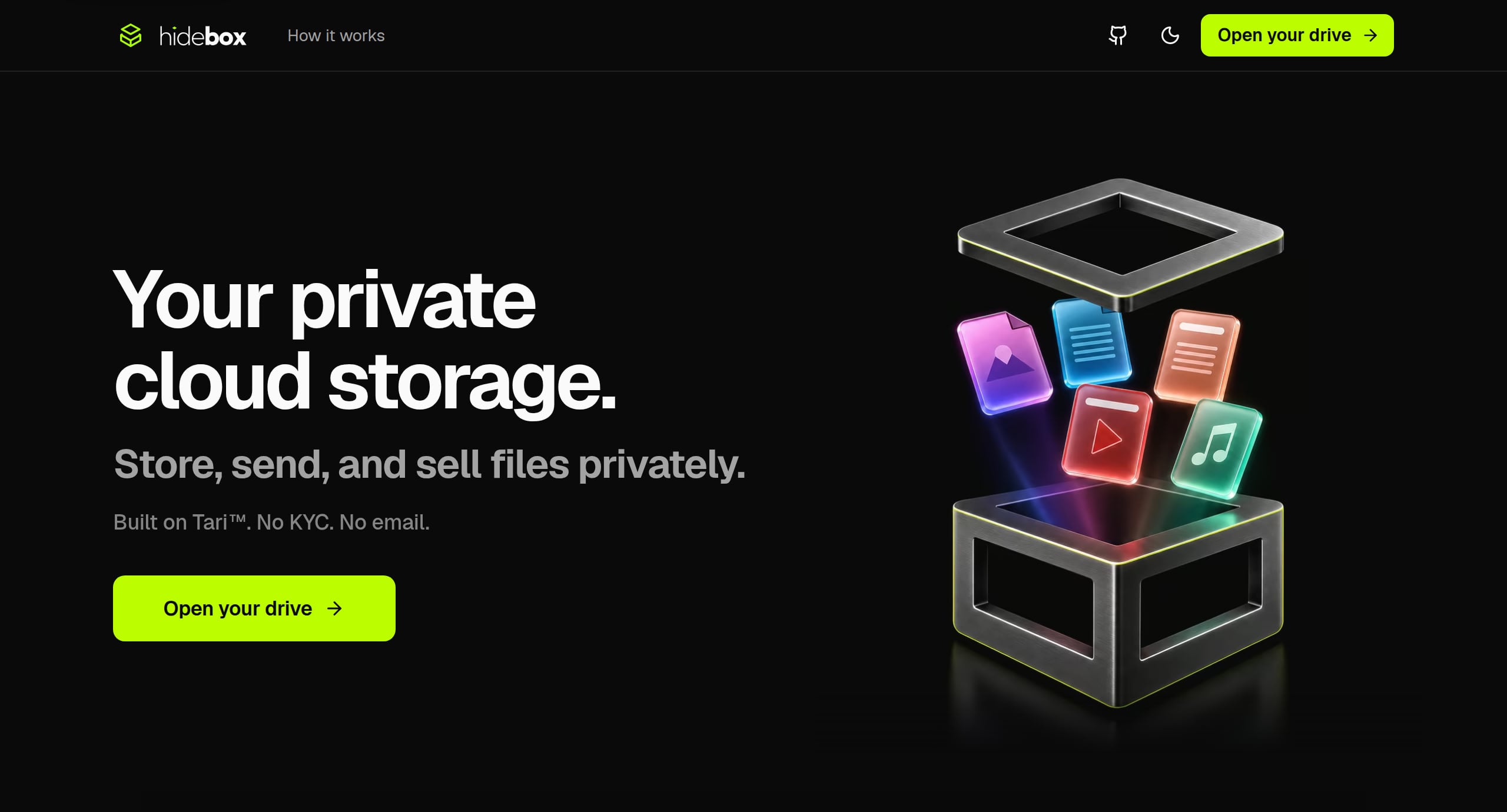
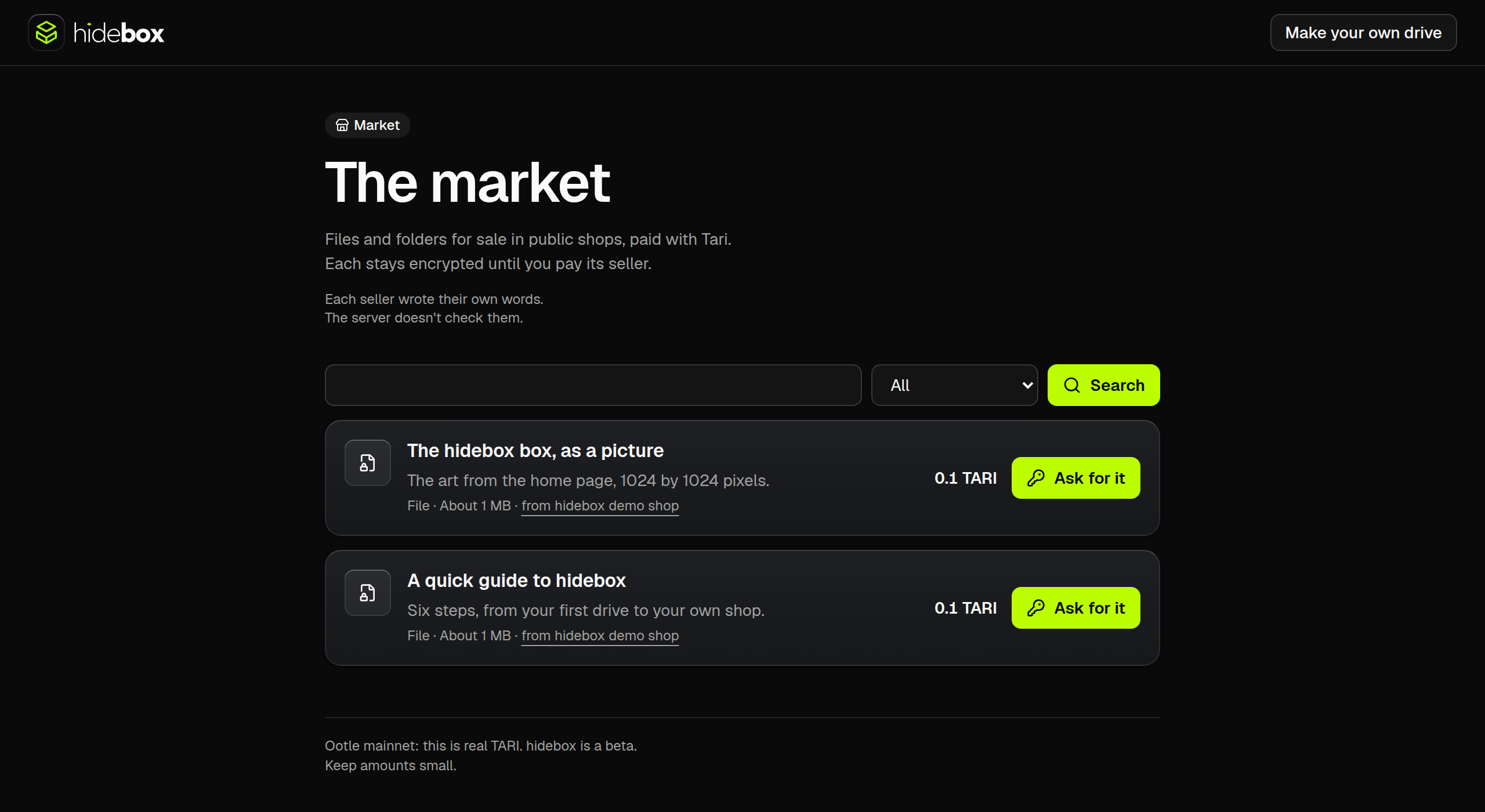
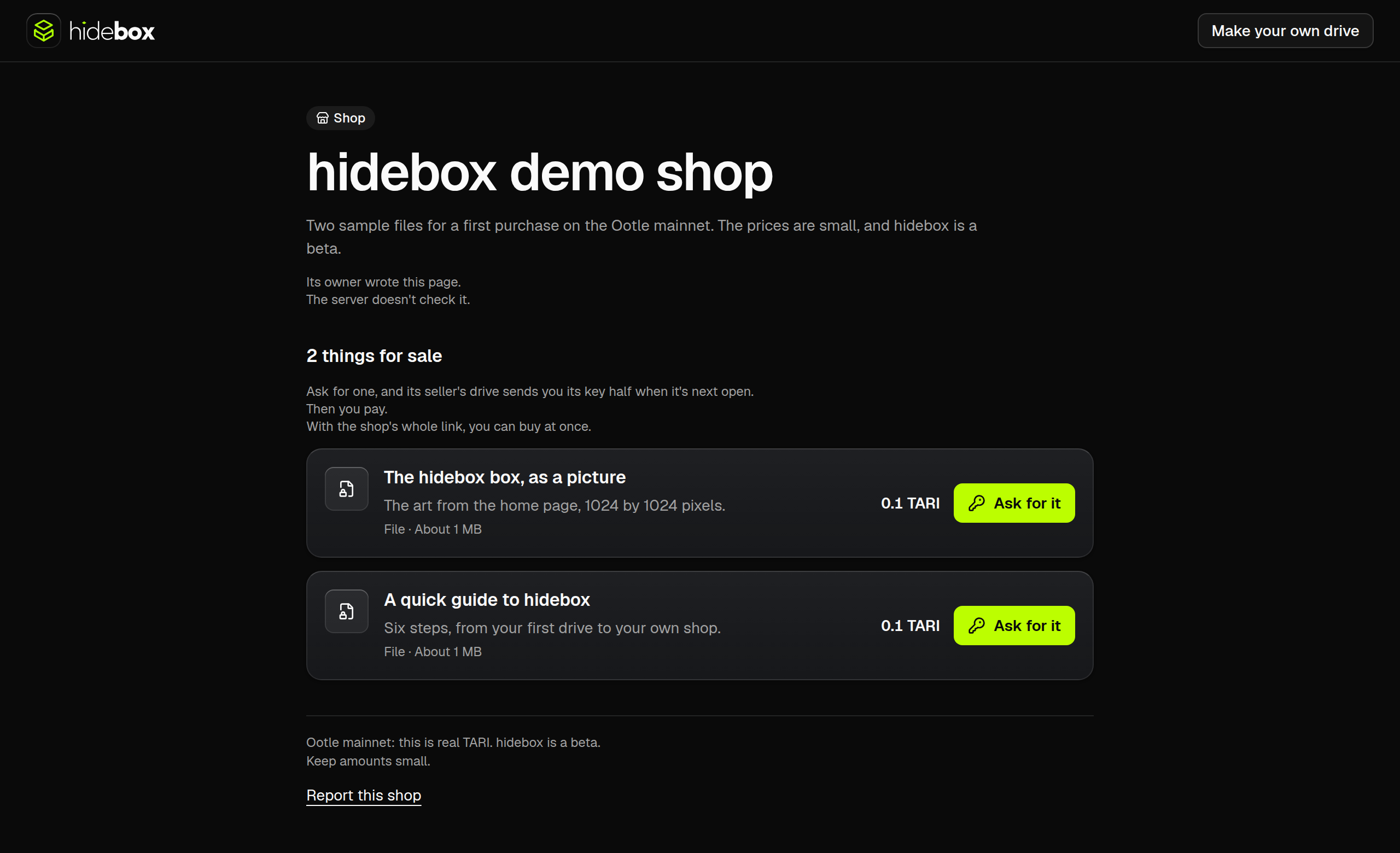
hi guys, sooo this is my MVP: hidebox.app now runs on Ootle mainnet. You can sell files for TARI, and the files stay encrypted.


What is new

  • A market for public shops: The market · hidebox
  • Your own shop, with a username that only you can use: hidebox.app/shop/<name>
  • The buyer pays your own Tari address. hidebox never holds the money.
  • Sales complete when you are offline. Our server checks them with a view key, which cannot spend.

Tari parts: stealth payments, view keys, encrypted memos, and SealLog, my contract on mainnet.

Links

Limits: This is a beta with real money and no outside audit. Our server sees your offline sales. In a public shop, our server could open your files. There are no refunds.

What stops you from selling your files here? :folded_hands:

Tari payment address: 12AbfZWFKurmwPqGprzVPnrLSMDeTNxDF3yxJYa3CKhiUDjrVx41TXYGUffn63kh8sqiXfmFWnz1ziP8QDLcZSwJkkz

hidebox is not affiliated with Tari Labs.

Launch Commitments: token launches you can check, not just trust

Code (MIT): GitHub - ManishModak/ootle-launch-commitments: Token launches on Tari Ootle that nobody can change, with allocations locked in Ootle Lockbox · GitHub (template + launch-cli); app code in GitHub - ManishModak/ootle-lockbox: Time-locks anyone can verify, on Tari Ootle: ownerless, no admin, no upgrades. · GitHub
App: Lockbox · time-locks on Tari Ootle
Tari payment address: 12AbQTXKowVAsHH7j8UXHPVasaKrTmuvTcTLNwmk5ZvzEQJ8fxGmQtEnQa5soA4EUoj6298tb3U7kH8xWFBiH3guwqS
Announcement: https://www.reddit.com/r/tari/comments/1xu5frf/launch_commitments_launch_a_token_on_tari_ootle/

What it is
A token factory for launches that holders can verify. One transaction:

  • creates a fixed-supply public token that nobody can ever change, its creator included: no owner, every rule and updater locked, only withdraw and deposit open, no transfer hook;
  • locks the creator’s chosen allocations (team, advisors, …) in Ootle Lockbox (my other entry, November Build Contest Thread: MVP! - #7 by Zein) until an epoch;
  • writes a read-only launch record that the token’s metadata points back to;
  • pays a flat launch fee. Through the app and CLI, a failed launch rolls back the token, locks, record and launch fee (normal network fees may still apply).

Why it matters on Ootle
A resource’s owner bypasses its access rules for everything except recall, so a token that says mint: DenyAll can still be minted by its owner. Launched tokens have no owner at all. The engine tests prove it with a positive control: an owned twin with the same rules, whose creator can mint, freeze and edit metadata, next to the launched token, where every one of those actions is refused.

What a holder sees
Each launch has a public page that checks four facts against the chain, separately: fixed supply, rules frozen, issued by Launch Commitments, and allocations locked at launch. It also shows how much is still locked now, since locks open at their unlock epoch. Each lock links to its own Lockbox proof page. The allocations are what the creator chose: the page proves which tokens were locked until when, not who the team is or who holds the rest.

Status

  • Live on mainnet: template_b18fc1ae9195b569362311b6719896aa84078aedf4cf70a4aba19d516bcc9963, published 12 Nov 2026, 04:48 UTC (tx 6930fcd46f6f3de375c30521c9a832a6c31d95cc993a6c2273426460168fa80b). It uses the mainnet Lockbox template template_968740ec9a0f3d368af2ba48d18af68bbb5c73a30ec582fbf9b00f90cb20ec72.
  • Mainnet launch fee: 2,500 TARI, fixed when the template was built, so it can never change.
  • Tested end to end on Esmeralda with the Sapient wallet and the CLI. Example launch page (testnet token LCDEMO2, 200,000 of 1,000,000 locked until epoch 14500): Lockbox · time-locks on Tari Ootle
  • Launch from the browser with the Sapient wallet, or from a terminal with launch-cli.

Stake: a private commitment contract

Code (MIT): GitHub - Mzee04/stake: Lock TARI against a private goal. A referee you trust decides. Commitment contracts on Tari Ootle. · GitHub
Running app (no wallet needed): Stake — a private goal, locked on Tari

I built Stake. You pick a goal, lock some TARI against it, and name a referee you already trust. If they say you kept it, the money comes back. If they say you didn’t, it goes to a friend or a cause you chose at the start. If they never answer, a default you picked then runs.

The goal itself never goes on the chain, only a hash of the wording and a salt. A debt, a health goal, or a habit stays private. Anyone with the original text and the salt can check that they match. The amount is public; it sits in a vault, and the page says so.

The referee can lie. That’s inherent, the same way it is on stickK, and I say so on the page, not only here. The chain cannot see whether you hit your goal. It only holds the money and follows the call.

The template is a small Rust #[template]: open, rule_success, rule_fail, timeout, and views, including a verify_goal check. Engine tests cover success, fail, a timeout that refunds, a timeout that pays the sink, a wrong referee, a double ruling, an early timeout, and payout accounts that don’t exist (20 tests, all against the real Ootle engine). The web app’s default path is a walletless simulation of those same rules, so you can create a stake, send a referee a link, rule, and try a timeout in the browser. The on-chain path is wired for Sapient / Tari Universe once I publish the template and put its address in the app.

I may build on this after I publish. The idea is December goals and the ones people set at the new year. You can walk through the whole product in the browser today; locking real TARI waits until I publish the template.

Tari payment address: 12EzpVBeVVin2bCRxg2rb7UtQJPoKV1VMRYCtYUiKct5GsZTL9dJE27LSLuE1YF7riXWMQTqr9PAckkyyLW5hSK4p4K
Announcement: @iammzee.bsky.social on Bluesky
Also on Reddit: https://www.reddit.com/r/tari/s/7eJCHa9fvv
Also on Medium: https://medium.com/@allahumuhyy767/i-built-a-commitment-contract-on-tari-and-left-the-goal-off-the-chain-b61785f0e38c

Ghostline — private pay-per-call for AI agents, live on Ootle mainnet

What it is. An agent locks a deposit in a channel, signs a cumulative voucher for each API call, and the service settles that total once. Calls stay off-chain. Settlement pays the service, sends 1% to the on-chain treasury, and returns the remainder to the payer. After expiry the payer can refund an unspent channel. A spending policy outside the agent enforces the budget, the per-call cap, the vendor allowlist and human approval. An MCP server exposes the paid call to the agent.

Why this is an MVP you can run today. Install the CLI, follow the mainnet quickstart, and open a channel with your own wallet. There is no hosted relay and no faucet: the deposit and the fees are your TARI. A service puts the paywall in front of an API, answers HTTP 402 with a quote, and settles when it chooses. The payout lands in the service wallet. The site is the docs, the fee calculator, a walletless privacy simulator, and the proof page. The product that moves funds is the CLI and the MCP server.

What changed after October. The October build ran on Esmeralda, with a two-output settlement and a custodial browser relay for the live demo. The November build is the mainnet product:

  • Channel template and fee-config published 13 Nov 2026. Settlement is three stealth outputs: service payout, payer change, and the 1% treasury fee. The channel reads the treasury key from the fee config on chain.
  • Five recorded mainnet runs: opens, settles, an expiry refund, an observer test with separate wallets, and an MCP run where the policy refused the sixth call (cumulative 6000 µT against a 5000 µT budget). Each transaction is on the proof page.
  • v0.5.0 is installable. ghostline demo runs the HTTP 402 path locally and does not submit a transaction.
  • The Esmeralda browser demo stays at Ghostline demo: simulate or run live as the October record. It targets the retired testnet template.

Published on mainnet, 13 Nov 2026 (indexer finalized_at, UTC)

Contract Address Time Transaction
Fee-config template template_b3628ed057f88c73b88f3c5653b494a10258067c43cf0c667d1dcf17e85e9f45 07:07:22 651aff4202a1dd6675c6d82903ebb036e6673075f06428dea8844d4d31a13983
Fee config component_37df6af59007b9c02ead46df7e320af4255978cf8fefb164fb8bfdc4183d0bb5 07:08:32 1fdbb90905399f5427ad2dc8894d84c43c44af4d6da83ce97f5f0f5b93211fd9
Channel template template_ae13cead3c34052116c49fc09e4645f3a62edf55857c0e2e45226dd7093cef9c 07:09:07 3ff0500cf6deef1c66dce31cce01e68105658b0ac9ae7043b7962649f17b2eec

Raw publish records: ghostline/deploy/evidence/mainnet-publish-2026-11-13 at main · AduAkorful/ghostline · GitHub

Honest limits. Unaudited; keep deposits small. Network fees, the open and close records, and any funding link you create are public. In the observer test the deposit, payout, protocol fee and payer change were commitments only. Call counts come from the service ledger. Opening plus settling costs about as much as 448 calls at 100 µT, so this fits an agent that calls often.

Ootle Fee Check — batch fee reconciliation for payment operators

A batch of transactions can include a successful transfer, a failed main intent whose fee was still charged, or a transaction for which one indexer has no receipt. Ootle Fee Check distinguishes these cases when preparing a fee ledger. Give it a list of public transaction IDs and it writes one row per distinct ID. Each row records the replies from Tari’s two public indexers and the UTC time of the check. When the fee or outcome differs, the amount stays blank. The browser flags the row for review and the CLI exits with status 2.

In the browser app, choose “Load 3 recent IDs” and then “Compare fees”. To try the CLI with PowerShell 7, extract the ZIP and run this command with a current transaction ID:

./Export-OotleFees.ps1 -TransactionId YOUR_TRANSACTION_ID

The included mainnet sample returned 15,901, 16,359 and 16,054 microtari for its three transactions. Both endpoints agreed on each amount when we checked on November 12. They are operated by Tari. Their agreement is an operational check and does not independently prove settlement.

HarbourRelay developed and tested this tool with AI assistance. The source and ZIP include the MIT license.

MIT source archive: Ootle Fee Check by HarbourRelay
Browser comparison code (plain JavaScript): https://html-classic.itch.zone/html/20487999/fees.js
App: Ootle Fee Check by HarbourRelay
Public announcement: https://www.reddit.com/r/tari/comments/1xv7dzb/i_built_a_csv_fee_checker_for_tari_ootles_two/
Tari mainnet payout address: 1245mAEaVBEhAKHwdVYFD4TLXpywJp22Q7dgUKCv1JugLvBkfN8CxdRcEcB2TgVUXRjrpFaTaCmJN8GFau5W2Mokrqo

Ootle Crowdfund is a minimum viable product for all-or-nothing crowdfunding on Tari Ootle — something a creator could use to fund their next project today.

How it works. A creator opens a campaign with a funding goal (TARI), a deadline (an Ootle epoch), a promise of what backers get (stored on-chain, labelled as the creator’s promise), and a bond of their own TARI — max(goal / 10, 100). Backers pledge TARI into the campaign’s vault. If the goal is missed by the deadline, every backer refunds in full and the bond returns to the creator. If the goal is met, funds release in three equal tranches gated 72 epochs apart — and backers holding more than half of the pledged value can veto any pending tranche; a successful veto (or the creator going silent past a gate) returns the remaining funds plus the forfeited bond to backers pro-rata. There is no platform cut, no custody beyond the template, and no account to create. One campaign is one component; the template emits CampaignCreated, Pledged, Funded, TrancheReleased, CampaignCompleted, VetoCast, VetoSucceeded, Abandoned, BondForfeited, BondReturned, and Refunded events for indexers. The mechanism — parameters with justification, threat model (including the fresh-account Sybil case), edge cases, and honest limits — is specified in docs/MECHANISM-V2.md.

What was built.

  • A small, focused Rust template (CrowdfundCampaign): vault escrow, a separate bond vault, epoch-based deadlines and tranche gates, signer-checked claim/veto/abandon/bond/refund, and events. Authorization is enforced in code against the transaction signer; the template creates no resource, so the owner-bypasses-rules trap cannot apply.
  • 52 engine tests run against the real Ootle engine in-process (no network, no funds): the v1 behaviors kept intact plus every v2 rule and edge case — tranche schedule and gates, veto below/at/above the 50% threshold (exactly 50% fails), tally reset on release, abandonment timing, bond minimum and return/forfeit paths, pro-rata refunds with bond shares, and vault + bond vault reconciliation on every path.
  • A browser demo whose default path is a walletless simulation: zero installs, zero wallet, zero funds, completable in about four minutes with a guided 16-step checklist covering the full mechanism including the deliberate rejections. The simulation mirrors the template’s rules and rejection messages exactly (46 parity tests).

Honest limits. No code can force a human to work or claw back released funds: a creator who takes tranche 1 and vanishes keeps tranche 1. The mechanism bounds the loss to released tranches, compensates backers from the bond on veto or abandonment, and keeps unreleased funds under backer control. The promise is stored, not enforced. A veto needs strictly more than half of pledged value, so minority backers are not protected against majority apathy. The bond prices dishonesty; it does not prevent it. The template has not been published to Esmeralda or mainnet; the demo is a simulation and says so on the page. Pledge amounts are public by design (vault accounting) — hiding them would need a confidential/stealth design. Live wallet mode is an honestly-labelled stub, not a working path. No on-chain claims are made that the code cannot back up; cargo test reproduces the template’s behavior exactly.

Code quality note. Development used an AI agent, as the rules allow. The code is original, MIT licensed, and written to be read: the template is one file with its invariants documented, and every rule has a test on both the engine side and the simulation side.

How to verify (for judges)

  1. Open the app link, follow the 4-minute walkthrough on the page (including the deliberate rejections).
  2. Clone the repo, run cargo test (52 engine tests, no network needed).
  3. Run node --test app/sim.test.mjs (46 simulation parity tests).
  4. Build the WASM: cargo build --target wasm32-unknown-unknown --release.

Update log

  • 15 Nov 2026: mechanism v2 — staged tranche release, pledge-weighted backer veto, creator bond, abandonment path, on-chain promise. Funding phase unchanged (all-or-nothing). 52 engine tests, 46 parity tests. Full spec in docs/MECHANISM-V2.md.

TariFund — crowdfunding with automatic refunds on Tari Ootle

A creator opens a campaign with a funding goal (in TARI) and a deadline (in epochs). Anyone can contribute. After the deadline, if the goal was reached the creator claims the whole vault; if it was missed, every contributor can refund their own contribution in full. No custodian, no platform fee — the contract enforces the rule.

What it is:

  • A Rust Ootle template: Campaign component with new / contribute / claim / refund / info / contribution_of / status. Amounts in micro-Tari; creator-only claim via component access rules; refunds always pay the contributor’s own account.
  • 10 engine tests passing against the real Ootle engine, covering the funded payout, full refunds, late contributions, early/below-goal claims, creator-only claim and the status lifecycle.
  • A walletless browser demo that runs the same rules, so anyone can try the full campaign lifecycle in two minutes — no wallet, no funds.

Why it matters: people raising money in TARI today have no native tool — fiat crowdfunding is custodial and takes fees; a multisig needs trust. TariFund is the trustless version. It is a product you could take to market today.

Honest limits: contribution amounts are public on chain, as with any vault deposit; the template has not been published to Esmeralda or mainnet yet and is not audited; there is no partial-funding payout by design — goal-or-refund is the whole point.

License: MIT. Built by an AI agent under its owner’s direction.

Code: GitHub - 0xfats/tarifund: TariFund — crowdfunding with automatic refunds on Tari Ootle. Entry for the Tari November Build Contest (MVP). · GitHub
Live demo: Tarifund Demo
Tari payment address: 125cwwkBcLMGRNnnwoozEKeWgWqnaEbuTNFRj8FGZTYFK48BNzy3c56yRhGeRp5y7sjzVfHvWL83xcHc4oauYzQuM3k
Announcement: https://www.reddit.com/r/CryptoCurrency/s/F88pobUDKH

**TariBill — payment links & invoices for XTM merchants**

TariBill turns anything you sell into a shareable payment link. A merchant creates a link (item, price in XTM, memo), shares it anywhere, and the buyer lands on a checkout page with a scannable QR code and an instant receipt. The merchant dashboard tracks links, payments and totals — everything a small seller needs to start accepting XTM today.

This build is a walletless browser MVP: payments are simulated in demo mode (honestly labelled in the app), with state kept in localStorage. The repository also includes a Rust Ootle component template (TariBillEscrow: create_invoice / pay / release / refund) that maps each simulated flow to its on-chain counterpart — that is the mainnet path on the roadmap, together with Tari wallet integration.

Code (MIT): GitHub - Klowor2002/taribill: TariBill — payment links & invoices for XTM merchants. Tari November Build Contest entry. · GitHub

Live MVP: TariBill — Payment links & invoices for XTM merchants

Announcement: @kingklowor.bsky.social on Bluesky

Tari payment address: 1254udGRBKwEA8rwRaoQMAHJmjY6e13fu7qNrBj7zvjg91MpmwCmLDdHQUDzJL9V5Rq2uUgcbJXVQ3BnhXwBgtioGoB

Built with an AI-assisted development workflow.

Ootle Bounty — Bug Bounty Escrow on Tari Ootle

A bug bounty escrow on Tari Ootle. A sponsor locks an XTM reward pool; researchers submit findings as commitments (SHA-256 hash + encrypted report); the sponsor triages them, and valid findings are paid out of the locked pool — once per hash, so duplicates can never be paid twice. After the deadline, findings can be disclosed and anyone can verify the disclosed text hashes to the original commitment.

Live demo: Ootle Bounty — Bug Bounty Escrow on Tari Ootle
Repository (MIT): GitHub - taufik52/ootle-bounty: Ootle Bounty — bug bounty escrow on Tari Ootle (Tari November Build Contest: MVP). Sponsor locks an XTM pool; researchers submit findings as hash commitments; sponsor triages, valid findings paid from the pool. · GitHub
Announcement post: https://medium.com/@capedong6/tari-web3-bug-bounty-blockchain-ootle-95ffb991428c
Payment address (XTM): 1Rcm4Nshc9gfUiCYspmthSyocSkAtNokKp8Lwm3QiMuCwM1jrP1RCDWxXU2BQzG9ERFduM4n2cyqmg1r8ZToBi68Fx

The demo is a simulation (no wallet, no real funds) that mirrors the real on-chain Rust template: 10/10 engine tests passing, 138 KiB WASM, with create_bounty, submit_finding, triage_valid, triage_invalid, disclose, and close_bounty. Honest limits are documented in the repo README — demo encryption is per-session AES-GCM, not production encryption, and the template can’t force honest triage (the commitment hash is the accountability mechanism).

Built for the Tari November Build Contest: MVP.